svelte.boulevardier
New in Town
- Messages
- 24
Hello everyone,
I've been putting together a small, open-source web app (all data is stored on your machine, nothing is ever sent to the server) called Valet (https://flaneurs.cafe/valet/) and wanted to share the idea behind it with you.
The main idea is to build a theory- and practice-based program free of myths that have been debunked by research and without ambiguous scores and feedback provided by AI. Everything should be explicable at all stages.
It is built with a specific kind of person in mind: someone who is just starting out or at an intermediate level with classic menswear, but isn't afraid of spending a bit more time setting things up.
When you're new to tailored clothing, most advice you come across falls into two traps: either rigid "never wear X with Y" rules with no explanation behind them, or quick capsule-wardrobe checklists that tell you what to buy without teaching you how to see. If you're the sort of person who is happy to grab a tape measure, read a few pages of books such as Alan Flusser's Dressing the Man, and take ten minutes to understand why a pairing works, you don't really need a shortcut, you need a framework.
Instead of trying to memorize thousands of individual outfit combinations, Valet tries to work from the underlying principles. Every rule in the app is separated by what kind of claim it actually is and graded with a badge:
Where a measurement disagrees with a rule of thumb, the measurement wins.
What it actually does? If you're willing to spend a little time setting up a profile, it walks through four main areas:
In the spirit of full transparency, I came up with the framework, the thresholds, and the wardrobe testing myself, and worked with an AI coding assistant (Claude, Opus 5.5) to help write the code and pull candidate rules from books and papers (in theory I could have written it all myself, but my professional life doesn't leave much free time for such projects). Right now, though, it has mostly been tested against my own wardrobe and my own eye in daylight. So treat its verdicts as reasoned study notes rather than gospel
If anyone here enjoys digging into the mechanics of colour, proportion, and pattern matching, whether you're just building your first proper wardrobe or have been wearing tailored clothes for decades, I’d genuinely appreciate you kicking the tires and telling me where you think the rules get it right or wrong.
I've been putting together a small, open-source web app (all data is stored on your machine, nothing is ever sent to the server) called Valet (https://flaneurs.cafe/valet/) and wanted to share the idea behind it with you.
The main idea is to build a theory- and practice-based program free of myths that have been debunked by research and without ambiguous scores and feedback provided by AI. Everything should be explicable at all stages.
It is built with a specific kind of person in mind: someone who is just starting out or at an intermediate level with classic menswear, but isn't afraid of spending a bit more time setting things up.
When you're new to tailored clothing, most advice you come across falls into two traps: either rigid "never wear X with Y" rules with no explanation behind them, or quick capsule-wardrobe checklists that tell you what to buy without teaching you how to see. If you're the sort of person who is happy to grab a tape measure, read a few pages of books such as Alan Flusser's Dressing the Man, and take ten minutes to understand why a pairing works, you don't really need a shortcut, you need a framework.
Instead of trying to memorize thousands of individual outfit combinations, Valet tries to work from the underlying principles. Every rule in the app is separated by what kind of claim it actually is and graded with a badge:
- A : Perception and colour science: Things grounded in how the human eye actually processes light, hue, contrast, and pattern scale (for example, why two stripes of the same width vibrate visually, or how your own skin/hair contrast frames what you wear).
- B : Tailoring convention: Established menswear principles drawn from classic texts and tailoring houses, citing the exact source so you can look it up yourself.
- C : Unsubstantiated folklore: Rules that get repeated online with no real basis in either perception or tailoring tradition. Valet leaves these out deliberately and explains why.
Where a measurement disagrees with a rule of thumb, the measurement wins.
What it actually does? If you're willing to spend a little time setting up a profile, it walks through four main areas:
- Your colouring & palette: You can take a daylight photo next to a plain sheet of white printer paper (so the app can correct for your camera's white balance) and sample your skin, hair, and eyes, or just pick them by name. From there, it builds a palette suited to your contrast and undertones.
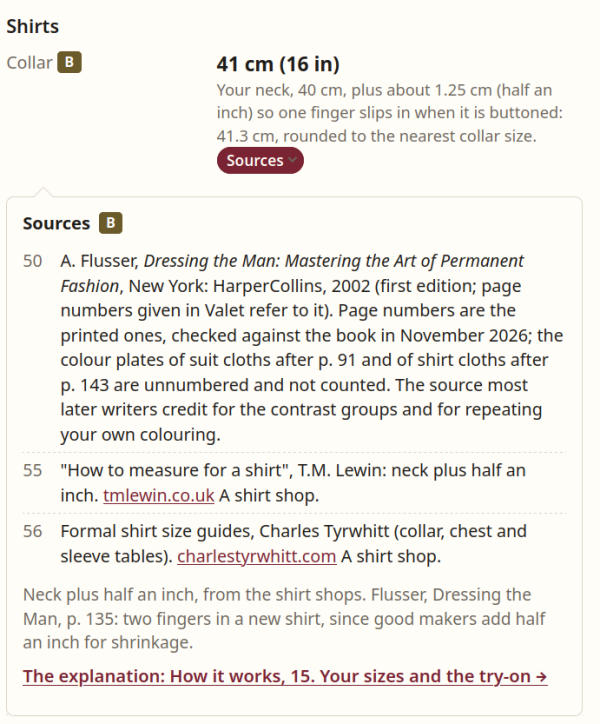
- Proportion & fit: You enter your body measurements (compared against survey data) to get concrete starting targets for things like collar size, sleeve/jacket length, trouser rise, and lapel width, along with notes on how different cuts balance your build.
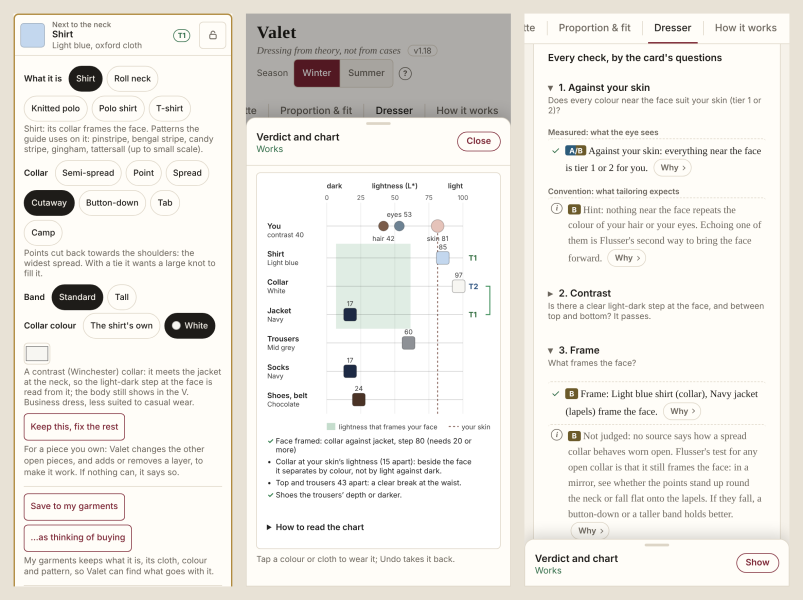
- The Dresser (outfit check): You can test combinations of garments, cloths, patterns, and colours for a given occasion and season. Rather than just giving a thumbs-up or thumbs-down, every verdict lists which rules passed or clashed, why they matter, and what small change would fix an issue.
- My garments: You can log pieces you already own (or are thinking of thrifting/buying) to see what outfits they make together and which colours would fill the gaps.
In the spirit of full transparency, I came up with the framework, the thresholds, and the wardrobe testing myself, and worked with an AI coding assistant (Claude, Opus 5.5) to help write the code and pull candidate rules from books and papers (in theory I could have written it all myself, but my professional life doesn't leave much free time for such projects). Right now, though, it has mostly been tested against my own wardrobe and my own eye in daylight. So treat its verdicts as reasoned study notes rather than gospel
If anyone here enjoys digging into the mechanics of colour, proportion, and pattern matching, whether you're just building your first proper wardrobe or have been wearing tailored clothes for decades, I’d genuinely appreciate you kicking the tires and telling me where you think the rules get it right or wrong.
Please, keep in mind that it is still a work in progress (an experiment is probably a better word).