Want to buy or sell something? Check the classifieds
  • The Fedora Lounge is supported in part by commission earning affiliate links sitewide. Please support us by using them. You may learn more here.

Origin of the Engineer's Boot

Trouser Bark

Banned
Messages
640
Location
Your Cerebral Cortex
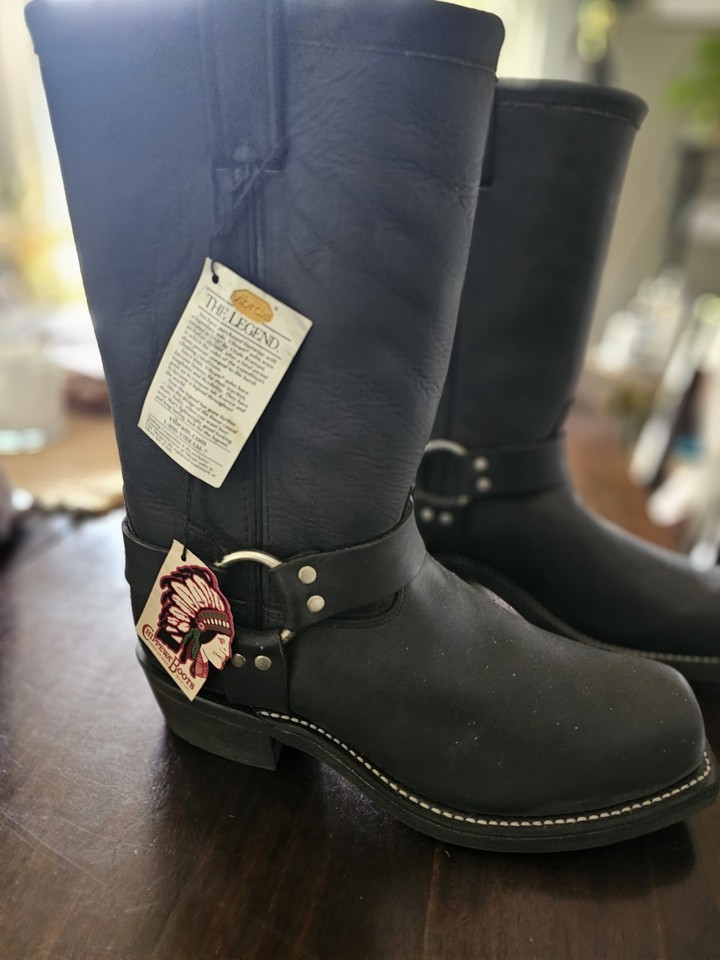
I bought a new (NOS) pair of Engineer's Boots this morning and it reminded me that I'd heard so much about these boots over time and much of what I'd heard seemed a little sketchy.

I've seen references on this site and elsewhere to Engineer's Boots having been developed for coal stokers on trains. That seems like such a tiny niche market that I couldn't imagine any mfg developing a boot specifically for guys that shovel coal for a living. I've also seen oblique references to Portland (OR) ship building facilities and welder attire, etc. Which mfg developed the idea and for whom seemed like it shouldn't be that muddy. Much of what I'd seen didn't make sense and with a couple hours of free time this morning I thought I'd dive down the rabbit hole and see what was in there.

There are multiple references on the web indicating that Chippewa was credited with the design years ago so I ran off in that direction first to see if there were any definitive references or any that contradicted.

A couple of enthusiast sites seemed like they may have been more enthusiastic than objective. Then I found a site that stated the same thing and it happened to be a vendor that had collaborated w/ Chippewa on a boot that was made exclusively for the vendor. The name of that outfit is Huckberry (I have no affiliation w/ them, never heard of them before today, etc.) and oddly enough the article they had written was recent.

In the 1930’s, the Wall Street crash and Great Depression eventually lead to the creation of programs like the CCC (Civil Conservation Corps.) and WPA (Work Progress Administration) to build up America’s infrastructure. The large labor force employed by these organizations needed all new boots that could hold up to the demanding work of the time. Chippewa responded with many new styles of work boot including the Engineer style boot — a tall, all-leather boot worn by railroad engineers that Chippewa is credited with inventing.
- Source


"Worn by" but not specifically developed for. Interesting. When I think of a stoker I think of a man that was probably less than affluent and probably would not have spent the inflation adjusted equivalent of what a set of Engineer's Boots would set you back today.

I don't normally think of Wiki as a reliable reference site but I don't think they're grossly off, either. This is what wiki had to say:

n the 1930s, the Wall Street crash and Great Depression led to the creation of programs like CCC and WPA to bolster America's infrastructure.[4] To provide the new employees with new high quality boots, Chippewa innovated work boots, including the Engineer style boot, which it is credited with inventing.
- Source


Looks a little like Huckberry may have pirated a reference or two from Wiki which could make both references trash so I checked Chippewa themselves to see if their site laid claim to either who invented it or what it was for and found this...

Chippewa Boots has never strayed from its roots. From inventing the original Engineer Boot to <snip>
- Source


I'm still not certain I know the original target demographic but it appears to have been a generalized boot development for a workforce that needed tough boots rather than a solution developed specifically for a train company's coal stoker.

Regardless, the boot design appears to have stemmed from government workforce contracts associated w/ rebuilding the US economy during and after the US Great Depression. It also appears that it was so widely regarded that nearly a century later it's still a tough boot and an xlnt choice.
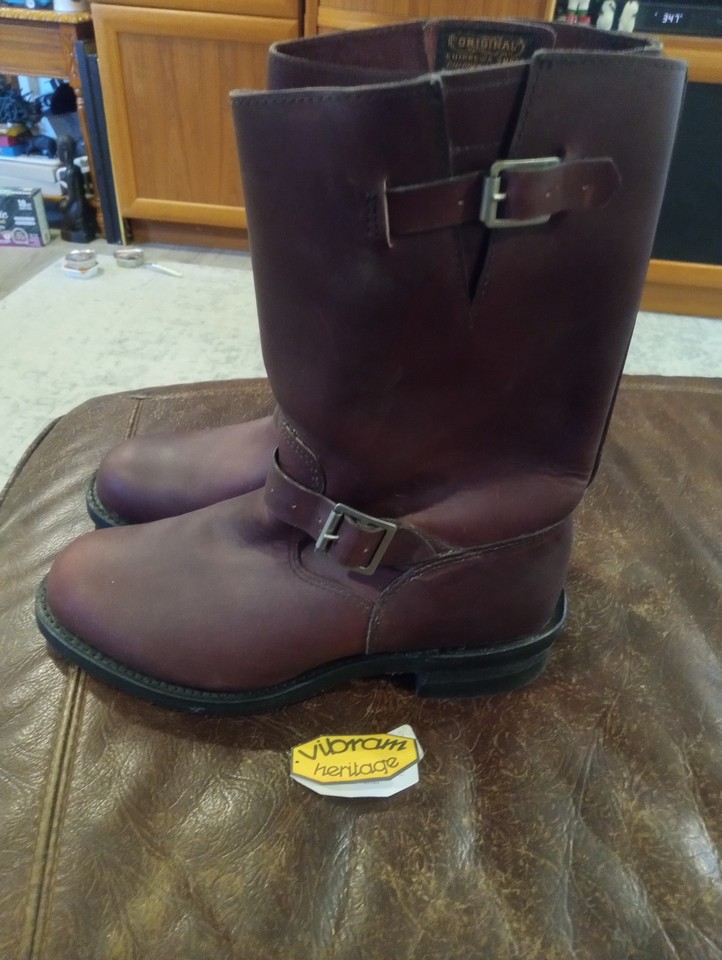
s-l960.jpg
 

Iron Horse

Vendor
Messages
73
AFAIK the myth that engineer boots were for train engineers is just that: a myth. But there are a number of myths in this denim/heritage scene that have cropped up over the past 20 years or so.

Anyway, the first catalog listings for engineer boots started appearing in Sears catalogs around 1936. In at least one catalog from the late 30s they're referred to as 'field engineer' boots and in at least one listing the illustration shows a surveyor wearing them. This was when they were offered in pull-on and lace-up versions. To confuse things further, I have seen one listing mentioning how they're ideal for train engineers as well. That said, in the thousands of vintage photos that I've gone through, I've never seen one of train workers actually wearing engineer boots.

As far as who invented them, I've yet to see any proof but they're obviously based on riding/cavalry boots. The high heel is great in a stirrup; it doesn't help much in a train caboose and really doesn't help in rocky terrain.

If I have time I'll post some photos.
 

Trouser Bark

Banned
Messages
640
Location
Your Cerebral Cortex
As far as who invented them, I've yet to see any proof but they're obviously based on riding/cavalry boots. The high heel is great in a stirrup; it doesn't help much in a train caboose and really doesn't help in rocky terrain.

Xlnt point. A guy that shovels anything for a living is leaned over and rising back up more than 50% of his work day. That's not the guy that's going to want to lean over an extra two inches for the next thousand shovel fulls for sure.

Interesting. Thanks.
 

RiteStuffBryan

One of the Regulars
Messages
191
Some catalog listings of engineer boots from the 1930s all the way up to the 80s or so:

IMG_0506.jpeg


IMG_7312.jpeg


Correction: Engineers’ Field Boots:

IMG_7080.jpeg

IMG_1910.jpeg


And yet every photo of actual train engineers shows them in regular lace-up boots, maybe arctics:

IMG_8302.jpeg
 

Trouser Bark

Banned
Messages
640
Location
Your Cerebral Cortex
Haha! For Mr. Doherty there a generous portion of coal dust and smoke wasn't enough. Had to have supplemental pipe smoke, too.

Very interesting. Thanks for contributing.

I grabbed another pair today that I assume are from similar origin but don't actually know. Had a pair something like them when I was a kid a few decades back. Aside from whatever's at the ankle they seem to be the same boot to my eye. The heel though. It seems to have grown since the early designs and the old guys in the train pics don't seem to be sporting tall heels themselves.

s-l960.jpg
 

Fifty150

Call Me a Cab
Messages
2,787
Location
The Barbary Coast
The heel though. It seems to have grown since the early designs and the old guys in the train pics don't seem to be sporting tall heels themselves.


Maybe it's fashion. Like how pants are cut. Pants flared out, then they tapered. There were cuffs, and straight hems. Some pants are cut at or above the ankle, to show off socks.


With any luck, we will never see the "barefoot" engineer boot. Imagine a flat foot boot with no arch support.
 

MrProper

I'll Lock Up
Messages
5,140
Location
Europe
With any luck, we will never see the "barefoot" engineer boot. Imagine a flat foot boot with no arch support.
Healthy, strong feet do not normally need arch support. I walk barefoot a lot and have never needed arch support. No heel is better for my hips and knees ;)
Of course, you can argue about the appearance lol
 

Fiedi

Familiar Face
Messages
55
Maybe it's fashion. Like how pants are cut. Pants flared out, then they tapered. There were cuffs, and straight hems. Some pants are cut at or above the ankle, to show off socks.


With any luck, we will never see the "barefoot" engineer boot. Imagine a flat foot boot with no arch support.
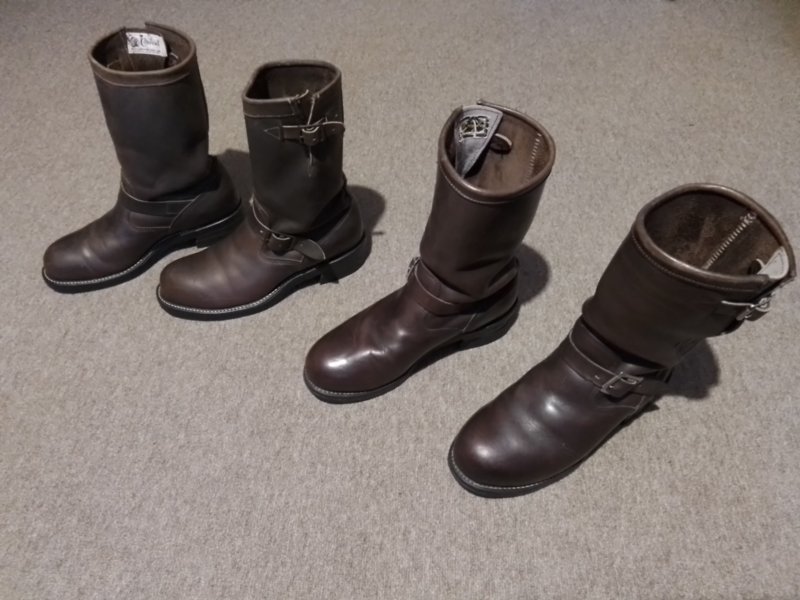
Hi, my first Engineerboots about thirty years ago were of Chippewa, undestructible and hard to find these days in Europe as there was no distributor - and buying in the www was just in the beginning or not really to use as a privatperson... now they are not built anymore and as far it concerns me this is ok as the late Chippewa Engineers made in China before the productionstop were of a far less quality compared to the earlier ones. For me Engineers alwas were the rebelboots James Dean wore in the film and wearing them develloped even some kind of this attitude - for sure when I wore them in my younger days I felt kind of unassailable and naturally one kick at the shinbone with this steeltoed ones would have solved any problem for sure - but this was never necessary as anybody not knowing me personally considered me a badass as I found out later and which is not true at all... ;)

According to your CCC point - I wore the Chippewas on the foto right for woodchopping in my midtwenties as I studied forestrysciences and for getting firewood in the BlackForrest. This seems to be amazing as they were really convenient in my point of view for this work, they were suitable anyway because of the steeltoes and the thick leather which even didn't suffer any damage...

If anybody is interested I am selling those on the foto
 

Attachments

  • 20251116_150821.jpg
    20251116_150821.jpg
    1.4 MB · Views: 72
Last edited:

Bfd70

I'll Lock Up
Messages
5,400
Location
Traverse city
Healthy, strong feet do not normally need arch support. I walk barefoot a lot and have never needed arch support. No heel is better for my hips and knees ;)
Of course, you can argue about the appearance lol
Healthy is probably a correct enough term, or at least easy enough to understand, but my feet are flat. Born that way always been that way. With no arch support I’m dying by the end of the day.
 

Fiedi

Familiar Face
Messages
55
We all don't have healthy, strong feet.


What comes to my mind is those logging and firefighting boots. They are designed with high heels and high arches. What if they simply made those flat?
Even if I got no problems to wear heels so far - ...obviously with flat soles like wedgesoles there were a lot more engineers, choppers etc. without orthopaedic problems in their old days
 

TartuWolf

Call Me a Cab
Messages
2,536
Location
Tartu, Estonia
What comes to my mind is those logging and firefighting boots. They are designed with high heels and high arches. What if they simply made those flat?
Rose Anvil discussed this topic in one video and the basic conclusion/idea was:
- If you're hauling around an unnaturally heavy load (logging equipment, full firefighter suit, etc..) then you are loading your feet more than "nature intended" and therefore high arches are a good idea in those scenarios.
- But if you're not carrying around extra heavy stuff then no arch support is healthier long term as it strenghtens your foot muscles over time.

Not sure about cases where folks are born with flat feet but in most cases flat footness can be healed/corrected with excercises and physiotherapy. Wearing high arch footwear is like a crutch for a broken leg or glasses for poor eye sight - they make the current state tolerable/workable but do nothing in terms of improving it.
 

Fiedi

Familiar Face
Messages
55
Rose Anvil discussed this topic in one video and the basic conclusion/idea was:
- If you're hauling around an unnaturally heavy load (logging equipment, full firefighter suit, etc..) then you are loading your feet more than "nature intended" and therefore high arches are a good idea in those scenarios.
- But if you're not carrying around extra heavy stuff then no arch support is healthier long term as it strenghtens your foot muscles over time.

Not sure about cases where folks are born with flat feet but in most cases flat footness can be healed/corrected with excercises and physiotherapy. Wearing high arch footwear is like a crutch for a broken leg or glasses for poor eye sight - they make the current state tolerable/workable but do nothing in terms of improving it.
Ok that's interesting, my last post was meant as a joke anyway. But compared to the beveled heels of a lot of cowboyboots especially those mexican made, I always felt these so called woodsmanheels much more convenient to walk around on hard ground like the most areas are in our asphalted cities. Of course you may reply cowboyboots are made for riding horses...
 
Last edited:

Edward

Bartender
Messages
26,271
Location
London, UK
Haha! For Mr. Doherty there a generous portion of coal dust and smoke wasn't enough. Had to have supplemental pipe smoke, too.

Very interesting. Thanks for contributing.

I grabbed another pair today that I assume are from similar origin but don't actually know. Had a pair something like them when I was a kid a few decades back. Aside from whatever's at the ankle they seem to be the same boot to my eye. The heel though. It seems to have grown since the early designs and the old guys in the train pics don't seem to be sporting tall heels themselves.

s-l960.jpg

Interesting how harness boots like these have become much more associated with engineer boots. They always seem to be to be a sort of middle point between a full on cowboy boot and an engineer... maybe the engineer association comes from bikers' adoption, especially within the element of bikerdom that might find a regular cowboy boot a bit too fancy, or even effete. Who knows.... The story always told about harness boots is they evolved from military riding boots, the harness being in position so that the fit could be snugged up by pulled leather out through the loop a bit and a heavy pin stuck through it. In truth, I've long been skeptical about how viable that would be in any pair of boots sturdy enough to be fit for purpose, but hey ho. Harness boots are a nice halfway house between a cowboy boot and an engineer, imo. Somewhat easier to find the right fit in than engineers, without being too challenging a la some western boots.

Maybe it's fashion. Like how pants are cut. Pants flared out, then they tapered. There were cuffs, and straight hems. Some pants are cut at or above the ankle, to show off socks.


With any luck, we will never see the "barefoot" engineer boot. Imagine a flat foot boot with no arch support.

Doubtless an element of fashion. I've often wondered whether the heels rose after they were adopted by bikers in the US, allowing for a grip on a motorycycle's foot peg. Akin to cowboy boots having the raised heel to better fit a stirrup. Though interestingly bike boots here in the UK, like English horse-riding boots, never had a particularly raised heel.


Red Wing makes a wedge sole engineer, it looks horrible but it's probably more comfortable:

View attachment 746308


Well, it's a very definite aesthetic that isn't going to appeal to everyone. I gather they are very comfy indeed, albeit that they look severely out of place to my eye. I could see it working better with a black coloured sole rather than the white. That said, I suspect these were designed as engineers for the guys who already like that sole. A lot of photos of Steve Macqueen wearing moctoes with the white wedge sole certainly helped to popularise it.
 

Forum statistics

Threads
114,462
Messages
3,175,118
Members
58,306
Latest member
Leather Pick
Top