Want to buy or sell something? Check the classifieds
  • The Fedora Lounge is supported in part by commission earning affiliate links sitewide. Please support us by using them. You may learn more here.

What Was The Last Movie You Watched?

Messages
18,300
Location
New York City
MV5BNGJmNjczYmYtODZjOC00OWFkLWFiZmQtMjNkYTUyNGQwNTBlXkEyXkFqcGc@._V1_.jpg

A Prize of Arms (1962) with Stanley Baker, Tom Bell, and Helmut Schmid


Most Heist movies follow one of two patterns: the common one is a timeline approach as the idea is discussed in Act I; intricate planning is done in Act II; and the heist itself is Act III. The other pattern gives us a glance at the heist first and then dissolves into the timeline approach.

A Prize of Arms cuts out most of the "boring" stuff by opening a day before the heist as the criminals are going through a dry run, doing last-minute prep, and fighting amongst themselves, which is never a good sign, but crooks tend not to be the most affable fellows.

Director Cliff Owen's approach is to grab you by the scruff of your neck and throw you right into it – a pace he mainly keeps up throughout. It also breaks with the traditional heist-movie mold by taking the usual Act III – the heist itself – and making it all but the entire movie.

Being "tossed right into the middle" means it takes you a bit to unravel the plan, which is to rob the army base payroll – a payroll stuffed to the gills as it is to be taken abroad when the troops move out to Suez (as part of the historical Suez Crisis).

Stanley Baker, Tom Bell, and Helmut Schmid play the gang members. Baker – dishonorably discharged years ago – is an embittered former soldier who planned this heist of an army payroll for, yes, the money, but also to seek revenge on the institution he thinks wronged him.

It's Baker's movie and he carries it with an on-screen intensity. Watch for the scenes when he barks at the other gang members to give him time to think – all heists have real-time challenges – and you'll see an actor using facial expressions and body English to hold your attention.

Very quickly, the men are on the army base in the morning dressed as soldiers because they need to prep for the evening heist by cutting alarm wires, setting up future diversions, and stowing gear and a vehicle. It is, though, hard to spend a day on an army base "incognito."

Several times one or the other gets called out by a superior officer or someone in authority, so much so that, at one point, the men even get in line to get inoculations for going to the Mideast. If you're not a military man/woman, you quickly learn how little of your life is your own on a base.

You know you're rooting for the wrong guys, but every time one of them nearly gets caught you're on edge. Baker's is a really smart, intricate plan that you want to see play out, but therein lies the inherent vice of most heist plans – the more moving parts, the more that can go wrong.

That is the crux of the movie as the heist rolls out slowly throughout the day and then picks up speed in the evening. Each of its intricate parts is a potential problem from securing a truck to escape in as part of the convoy to blowing the payroll safe open – nothing is easy.

The movie shines in those moments as they are the nail-biters, but Owen smartly makes his movie equally about the men, Baker in particular. He's an intelligent man who clearly made some wrong turns in life as, otherwise, he'd be successful and on the right side of the law.

Oddly, as you watch him manage the two men under him and deal with problems in real time, you think, "My God, he should have done well in the military." Companies, sports teams, even bureaucracies also need men like this, but alas.

Act III in an all-Act-III-like movie finds the boys with the money on the road, but will they make it? Based on the date the movie was made you can probably guess the answer, but like everything in this tense, short movie, it's well done with little wasted words or footage.

A Prize of Arms, shot in black and white and filmed primarily at a Naval Air Station, is an example of what postwar British cinema did so well: with a modest budget it made "small" plot- and character-driven movies that were counter-programming to Hollywood's extravaganzas.

Today they are still small gems to be discovered by old movie fans who treasure story and character over special effects, widescreens, bold colors, or shiny, perfectly coiffed stars. They harken back to storytelling's roots of yarns being spun around a campfire.
 
Messages
18,300
Location
New York City
jackal2.jpg

The Day of the Jackal (1973) with Edward Fox and Michael Lonsdale


The Day of the Jackal is so smartly written, directed, and acted that its brilliance lies in its simplicity. With few special effects or auteur flourishes, the story unfolds almost like a documentary, but one so gripping you often forget you're watching a movie.

History records that President Charles de Gaulle wasn't murdered, so the tension in this assassination-attempt story is seeing how the assailant, played by Edward Fox, tries to do it, and how the lead detective, played by Michael Lonsdale, tries to stop him.

Fox is hired by a secret group of former French military officers angry that France granted Algeria independence – boring then, mind-numbingly boring today. Fox has the advantage of secrecy, but he's also a lone wolf trying to defeat the entire state security apparatus.

As evidence slowly accumulates that there is a professional assassin targeting President de Gaulle, senior French government officials turn the search over to the highly respected Lonsdale – a detective who says little but whose every word means something important.

That's the set-up with the rest of the movie being a tense back and forth between Fox's meticulous plans and Lonsdale's equally meticulous investigation.

The small details take on an intensity as Fox acquires a g*n he can hide inside a crutch, buys a fake passport and steals another, scouts out locations from which to take the shot, and even fakes being (using a term of the day) a cripple with only one leg.

Fox's unemotionally professional approach to his insane "job" is impressive as he goes about his plan with incredible thought, precision, and attention to detail, all but unfazed by several setbacks – the French discover his identity, his car, etc. – that would have broken a lesser man.

He is also ruthless, coldly committing a few murders necessary to his mission of people who randomly get in his path or whom he needs to use briefly. The assassin business requires psychotic skills, but wonderfully, there's no modern obsession with his mental state.

Lonsdale matches Fox as his task is finding a needle in a giant haystack, but he has his own impressive skills: he knows how to marshal the large army of bureaucrats at his command, and he has a detective's mind that sees tiny, seemingly random dots and connects them.

Watch for the scenes of that army of bureaucrats going through massive files – hotel registries, passport details, old death records – where director Fred Zinnemann makes something that should be eye-bleeding boring into tense cinema.

Lonsdale also proves to have another skill that any successful government worker needs: he can manage those above him. He only bucks his managers – here the top officials in the government – when he has all, truly all, of his supporting evidence at the ready.

Again, something that should be boring, a meeting of cabinet officials questioning a police detective becomes edge-of-your-seat movie watching as Lonsdale, a lowly official in a room full of high-powered men, manipulates the meeting, time and again, to the outcome he needs.

Of course the climax comes down to the last second, but it's not over the top with a billion b*llets spent and shattered glass and objects everywhere; it's dramatic in its tense, believable terseness – no CGI available; no CGI needed.

That is what distinguishes The Day of the Jackal to this day: it doesn't need special effects or CGI. A remake would ruin it as it would become just another amped-up-on-steroids spy "thriller" that looks like every other amped-up-on-steroids spy thriller.

Here you care about the small details because Zinnemann, Fox, and Lonsdale give you a reason to believe in their meaning and importance. When Fox takes a quick imprint of a key he'll need later, you're nervous whether he'll get caught at that moment.

That is ten-times better than having Fox run over rooftops "dodging" a spray of machine g*n fire (that would never miss him in real life) – which is not a scene in this movie because it wouldn't fit in this movie in any manner.

By the 1980s and definitely the 1990s, movies like these were rarely getting made as "spectacles" or "blockbusters" drove the economics of Hollywood, which made pictures louder and special-effects packed, but also much less thoughtful.

There is some s*x and brief n*dity, but this movie could have been made under the Motion Picture Production Code without losing much, yet it could never be made today. The DNA of most movies has changed – and not for the better.

The Day of the Jackal endures because it understands that storytelling is the point. Technique, tension, even violence are all subordinate to clarity, patience, and trust in the audience. Zinnemann never asks the movie to impress; he asks it to persuade.

A modern director could equally stand out by making a spy thriller light on CGI and spectacle, heavy on intelligence and restraint – even if that meant working outside the mainstream. Ironically, what once looked modest now feels radical.
 
Messages
18,300
Location
New York City
dvwbdagf.jpeg

Dark Victory from 1939 with Bette Davis, George Brent, Geraldine Fitzgerald and Humphrey Bogart


*** Just an FYI, I wrote this years ago and there are several spoilers in it, something I haven't done in years, so please don't read it if you want to see the later twists and climax fresh. ***


The two things to know about Dark Victory are, one, Warner Bros. set the melodrama dial to ten and, two, this is Bette Davis' movie from the first scene to the last.

George Brent and, more so, Geraldine Fitzgerald deliver strong performances in supporting roles. But it is Bette Davis' performance that – as a socialite forced to face a personal crisis in a life, heretofore, that had only known luxury and frivolity – drives the picture.

Davis is the leader of the young social set, which spends all day every day partying, drinking, playing tennis, riding horses, making “smart” comments, dressing to the nines, and looking beautiful doing it – all supported by money someone else, born before them, earned.

Davis is cute, flirty, confident, playful, strong willed, and carefree. She knows she's rich, pretty and personable and enjoys being so. Yes, she's a bit obnoxious to her horse trainer, awkwardly played by Humphrey Bogart just before his career breakout, but even he kinda likes his spoiled boss.

Then tragedy hits when Davis is diagnosed with a brain tumor by a specialist, played by Brent. The rest of the movie can be seen through a modern filter of Davis' character forced to go through the five stages of grief, twice.

Davis rips through denial, anger, bargaining, depression and acceptance as she comes to understand she needs brain surgery. It's an acting tour de force that could have slipped into camp, but not in Davis' sure hands.

Davis goes through her emotional odyssey with her best friend and sort of foil, played by Fitzgerald, always by her side, but she also begins to fall in love with her doctor and putative savior Brent.

He, a serious man of science, can't help falling for Davis' force-of-nature personality, energy and, ultimately, courage. All would have been fine for these two had the surgery been a success, but alas.

Dark Victory puts Davis and the audience through the emotional meat grinder twice as we learn that the surgery, which improved all her symptoms, did not cure the underlying pathology.

This is where Dark Victory goes into melodrama hyperdrive, as Brent and Fitzgerald collude to keep this news from Davis. Today, we have completely different (and better) medical ethics, but their intention was kind and consistent with the values of the day.

When Davis uncovers this ploy in a series of powerful scenes culminating in Davis lowering the boom on the two conspirators in dramatic fashion, the movie enters its final phase as Davis has to, once again, go through the five stages.

This time, Davis initially spins further out of control (only limited by the Motion Picture Production Code, which kept her from having the bodice-ripping night of passion she wanted to have with Bogie's character). Then, though, she wheels it all in for a forced but movingly stoic finale.

Brent is good as the doctor in love with his very sick patient, but his contribution is not getting in the way of Davis' performance. Fitzgerald, either by instinct or thoughtful understanding of her role, contributes more as a sort of "anti-Davis" who quietly calls her best friend out on her bad and, sometimes, stupid behavior, while loving her all along.

You also want to look for Ronald Reagan in a small and atypical role as a drunkard pl*yboy whose character, in a later kind act toward Davis, proves to have more mettle and insight than his early casual attitude led you to believe. It's a talented bit of acting.

It is Bette Davis, though, who takes the viewer on a poignant journey of personal discovery with her portrayal of a seemingly frivolous woman who, when forced to face incredible challenges, proves to have previously undiscovered depths of character and courage.

Dark Victory is melodrama; it is Bette Davis, and it is very good.
 

Edward

Bartender
Messages
26,351
Location
London, UK
View attachment 768153
The Day of the Jackal (1973) with Edward Fox and Michael Lonsdale


The Day of the Jackal is so smartly written, directed, and acted that its brilliance lies in its simplicity. With few special effects or auteur flourishes, the story unfolds almost like a documentary, but one so gripping you often forget you're watching a movie.

History records that President Charles de Gaulle wasn't murdered, so the tension in this assassination-attempt story is seeing how the assailant, played by Edward Fox, tries to do it, and how the lead detective, played by Michael Lonsdale, tries to stop him.

Fox is hired by a secret group of former French military officers angry that France granted Algeria independence – boring then, mind-numbingly boring today. Fox has the advantage of secrecy, but he's also a lone wolf trying to defeat the entire state security apparatus.

As evidence slowly accumulates that there is a professional assassin targeting President de Gaulle, senior French government officials turn the search over to the highly respected Lonsdale – a detective who says little but whose every word means something important.

That's the set-up with the rest of the movie being a tense back and forth between Fox's meticulous plans and Lonsdale's equally meticulous investigation.

The small details take on an intensity as Fox acquires a g*n he can hide inside a crutch, buys a fake passport and steals another, scouts out locations from which to take the shot, and even fakes being (using a term of the day) a cripple with only one leg.

Fox's unemotionally professional approach to his insane "job" is impressive as he goes about his plan with incredible thought, precision, and attention to detail, all but unfazed by several setbacks – the French discover his identity, his car, etc. – that would have broken a lesser man.

He is also ruthless, coldly committing a few murders necessary to his mission of people who randomly get in his path or whom he needs to use briefly. The assassin business requires psychotic skills, but wonderfully, there's no modern obsession with his mental state.

Lonsdale matches Fox as his task is finding a needle in a giant haystack, but he has his own impressive skills: he knows how to marshal the large army of bureaucrats at his command, and he has a detective's mind that sees tiny, seemingly random dots and connects them.

Watch for the scenes of that army of bureaucrats going through massive files – hotel registries, passport details, old death records – where director Fred Zinnemann makes something that should be eye-bleeding boring into tense cinema.

Lonsdale also proves to have another skill that any successful government worker needs: he can manage those above him. He only bucks his managers – here the top officials in the government – when he has all, truly all, of his supporting evidence at the ready.

Again, something that should be boring, a meeting of cabinet officials questioning a police detective becomes edge-of-your-seat movie watching as Lonsdale, a lowly official in a room full of high-powered men, manipulates the meeting, time and again, to the outcome he needs.

Of course the climax comes down to the last second, but it's not over the top with a billion b*llets spent and shattered glass and objects everywhere; it's dramatic in its tense, believable terseness – no CGI available; no CGI needed.

That is what distinguishes The Day of the Jackal to this day: it doesn't need special effects or CGI. A remake would ruin it as it would become just another amped-up-on-steroids spy "thriller" that looks like every other amped-up-on-steroids spy thriller.

Here you care about the small details because Zinnemann, Fox, and Lonsdale give you a reason to believe in their meaning and importance. When Fox takes a quick imprint of a key he'll need later, you're nervous whether he'll get caught at that moment.

That is ten-times better than having Fox run over rooftops "dodging" a spray of machine g*n fire (that would never miss him in real life) – which is not a scene in this movie because it wouldn't fit in this movie in any manner.

By the 1980s and definitely the 1990s, movies like these were rarely getting made as "spectacles" or "blockbusters" drove the economics of Hollywood, which made pictures louder and special-effects packed, but also much less thoughtful.

There is some s*x and brief n*dity, but this movie could have been made under the Motion Picture Production Code without losing much, yet it could never be made today. The DNA of most movies has changed – and not for the better.

The Day of the Jackal endures because it understands that storytelling is the point. Technique, tension, even violence are all subordinate to clarity, patience, and trust in the audience. Zinnemann never asks the movie to impress; he asks it to persuade.

A modern director could equally stand out by making a spy thriller light on CGI and spectacle, heavy on intelligence and restraint – even if that meant working outside the mainstream. Ironically, what once looked modest now feels radical.

I remember seeing the 1997 loose-remake with Bruce Willis. Critically panned at the time by critics who compared it unfavourably to the original. It was quite a box office success, though largely bland and forgettable imo. I'd be interested to see the television version (now into its second season, I believe), with Eddied Redmayne in the lead when it comes to a service I use. All I really know about it directly currently is that the writers went back to the source novel as a starting point, though set the storying the present day (the first series aired in 2024). These days for a work of any complexity I'm increasingly drawn to preferring a six-part series over a feature film length if it means there's the room to explore the plot and let it develop as a decent pace rather than a rush.
 
Messages
12,506
Location
Orange County, California
I remember seeing the 1997 loose-remake with Bruce Willis. Critically panned at the time by critics who compared it unfavourably to the original. It was quite a box office success, though largely bland and forgettable imo. I'd be interested to see the television version (now into its second season, I believe), with Eddied Redmayne in the lead when it comes to a service I use. All I really know about it directly currently is that the writers went back to the source novel as a starting point, though set the storying the present day (the first series aired in 2024). These days for a work of any complexity I'm increasingly drawn to preferring a six-part series over a feature film length if it means there's the room to explore the plot and let it develop as a decent pace rather than a rush.

I remember seeing the 1997 remake after it had it's run in theaters and was released on videotape. That said, while I do remember watching it, the only thing I can remember about the movie itself was that it was awful. None of the actors seemed to be interested in their characters or the story, so it was two hours spent watching them go through the motions without a care.
 

Edward

Bartender
Messages
26,351
Location
London, UK
I remember seeing the 1997 remake after it had it's run in theaters and was released on videotape. That said, while I do remember watching it, the only thing I can remember about the movie itself was that it was awful. None of the actors seemed to be interested in their characters or the story, so it was two hours spent watching them go through the motions without a care.

TBH, the only thing I can remember about it now was there being a mild controversy that quickly blew over in regard to the Jackal pretending to be *** in order to secure one of his shooting locations. Something that I suspect in 2026 would go entirely unremarked.
 

Harp

I'll Lock Up
Messages
9,014
Location
Chicago, IL US
I'd be interested to see the television version (now into its second season, I believe), with Eddied Redmayne in the lead when it comes to a service I use. All I really know about it directly currently is that the writers went back to the source novel as a starting point, though set the storying the present day (the first series aired in 2024). These days for a work of any complexity I'm increasingly drawn to preferring a six-part series over a feature film length if it means there's the room to explore the plot and let it develop as a decent pace rather than a rush.
I've only caught the Redmayne series on YouTube episodic clips; however, on the whole a not bad effort. The first series season featured a MI5-6 black female agent, largely as ballast weight against what essentially is a man's world story, which threw off center the entire project to share focus with Redmayne's Jackal, a decided mistake. Redmayne is fascinating as was Edward Fox in the original, but aside passing professionalism, this second act is entirely different and divorced, with more biographic background filler.
A must catch on cable.
 

Harp

I'll Lock Up
Messages
9,014
Location
Chicago, IL US
Liam Neeson, Marlowe (2022).

Set in pre-Second World War Los Angeles at close of the 1930s, Neeson; who's always good, tackles the noir private eye genre as Philip Marlowe, bringing seldom equaled credibility and world weariness to the role of Hollywood ace gumshoe.

I found myself lost in the typical LA storyline, since I just focused on Neeson's superb character portrayal, which is more than sufficient cause to be seated, cold beer in tow and go along for the ride. :cool:
 

Edward

Bartender
Messages
26,351
Location
London, UK
Liam Neeson, Marlowe (2022).

Set in pre-Second World War Los Angeles at close of the 1930s, Neeson; who's always good, tackles the noir private eye genre as Philip Marlowe, bringing seldom equaled credibility and world weariness to the role of Hollywood ace gumshoe.

I found myself lost in the typical LA storyline, since I just focused on Neeson's superb character portrayal, which is more than sufficient cause to be seated, cold beer in tow and go along for the ride. :cool:

I caught this on a plane a couple of years ago, and thoroughly enjoyed it. It felt like something that was made either as a pilot, or which was intended as the beginnings of a franchise that was dropped if the box office was underwhelming. I enjoyed it very much, and would love to have seen it picked up for a further run by something like Prime or Apple TV. Neeson was always a superb character actor before being thrust into the leading man roles (which he did so well) after Schindler. His later rebirth as something of an action hero has been rather fun, though should he choose to make another switch I think this sort of period noir would work very well for him. Or back to comedy - his guest turns in Derry Girls on the small screen were a joy; I've yet to see his Naked ***, though it did review well.
 

Doctor Strange

I'll Lock Up
Messages
5,283
Location
Hudson Valley, NY
SORRY FOLKS, I MEANT TO POST THIS ON THE TV THREAD. D'OH!

I'm surprised to report that I'm enjoying HBO's A Knight of the Seven Kingdoms.

I'd loved Game of Thrones (and not having read the books, I didn't freak out at the differences or feel betrayed by the wonky last season) but I've found House of the Dragon only barely entertaining enough to stick with ('cause there's basically nobody to root for among those Targaryen nutjobs).

But A Knight of the Seven Kingdoms is short - only six half-hour eps - and delightfully different. We're just hanging with the smallfolk at the roughly midway point between the other series, timeline-wise. There are Targaryen and Baratheon nobles around the periphery, but they aren't the focus, it's on a modest hedge knight just starting out after being the squire to another hedge knight who died.

Anyway, it's been a nice change from the political machinations of the other shows, and it took three eps for it to come up with a patented George R. R. Martin surprise... thankfully not a murder, for once. Definitely recommended if you want to spend quality time in Westeros.
 
Last edited:

Harp

I'll Lock Up
Messages
9,014
Location
Chicago, IL US
- his guest turns in Derry Girls on the small screen were a joy;
Derry Girls I know of, sorted back burner once for an excellent Lady Chatterley; hence forgotten. Along with Branagh's last ol' sod, Belfast. Along with Colm Toibin's Brooklyn, which I'd read for film prep. Along with Brosnan's The Last *****man. Speaking of Brosnan, his Bond is the best of the lot; including Connery, largely due his more adroit capture of character. Pierce lad plays 007 straight down line as suave, not sociopath. And had he been given better script material, his Nihil Obstat franchise imprimatur would be sealed. Admittedly, mine is ethnically biased take, but Celtic dominance cannot be denied. And Branagh's Hamlet; particularly the Crispin's Day speech prior Agincourt is best oratory writ Bard.
 
Last edited:
Messages
18,300
Location
New York City
jintofear.jpeg

Journey into Fear (1943) with Joseph Cotten, Orson Welles, Dolores Del Rio, Ruth Warrick, and Everett Sloane


Produced and co-directed by Orson Welles – who also plays a pivotal character – and starring Joseph Cotten and Welles' usual collection of Mercury Theater troopers, Journey into Fear should be an A picture, but it plays more like a one-hour episode of The Twilight Zone.

It is even confusing as heck, like some of those The Twilight Zone shows. It's 1940, the war is on in Europe, but America is happily still out of it. Yet, an American armaments businessman, played by Joseph Cotten, is in Istanbul to sell weapons to the Turkish government.

The Germany's WWII-era leaderships want to stop the sale and will murder Cotten if need be. So the super-efficient Germany's WWII-era leaderships send a hitman and another man to watch the hitman, yet somehow they struggle in the chaos of Turkey (which should help them) to kill Cotten. Looked at that way, the plot is silly.

You really don't look at it that way, though, as it takes a while to boil the plot down to its core. Not helping things are a host of oddball characters, including Welles, who plays a Turkish colonel but, as always, he's really just playing Welles. His colonel character might be trying to help Cotten.

Cotten, in Istanbul with his wife, played by Ruth Warrick, is ushered by Welles onto a tramp steamer to get him out – in theory, to save Cotten's life from the Germany's WWII-era leadership assassin. Meanwhile, Welles will personally esc*rt Warrick by train to meet her husband in Batumi.

On the ship, the movie's second act takes off as Cotten discovers the Germany's WWII-era leadership hitman is also on board, as are a collection of shady characters and one potential femme fatale, played by Dolores Del Rio. The ship is a nest of vipers seemingly all with an agenda involving Cotten.

After surviving the journey, Cotten faces more attempts on his life while staying at a hotel with his wife in Batumi, as he is still being stalked by the German assassins. They clearly are not good at their jobs, but they are, like good Germany's WWII-era leaderships, relentless and menacing looking.

The story, mangled from a smartly-plotted novel by Eric Ambler, is too confusing to be easily followed – which can work if you're engaged with the characters. Yet, while Cotten is always interesting, the movie is too disjointed to allow you to love or hate any of the players.

Scenes and characters come and go in the chaos of Turkey's nightlife and then the claustrophobic tramp steamer. Several of the transitions seem intentionally confusing, so you're wondering where you are while trying to keep up with the plot.

The movie opens strong with a Godfather-like look at a hitman preparing to commit murder – but still, the overall picture, which has other good sequences, never gels as one cohesive movie. It's visually very Welles: a high-art European version of American noir.

Everett Sloane is excellent as a Turk, perhaps trying to help Welles, but he slips away early. Warrick exists less as a character and more as a symbol of Cotten's healthy American life away from all the dirt of Europe. Even Del Rio, who does a lot with a little, never feels complete.

Del Rio should have had a future in film noir with her dark, smoldering look and impassive expressions when called for, but her femme fatale future never happened. Had she, Claire Trevor and Marie Windsor would have had more competition for roles.

At just over an hour, with a good cast and Welles' imprint everywhere, it's an interesting effort even if not a great movie. The "boy genius" rarely made a bland film. In Journey into Fear, what he made is a very good episode of The Twilight Zone, but a mediocre motion picture.
 

Harp

I'll Lock Up
Messages
9,014
Location
Chicago, IL US
^ Cotton, like Liam Neeson decades later, had it all down in spades. Though the Ottoman plot
mixed Teutonic intrigue, does seem off kilt; Berlin having enough Polish sausage on its plate
to contend with. However, Welles possessed a vivid imagination, sometimes leading down a nondescript dark alley which could work with appropriate script, or not. Citizen Kane forgives much artistic license illogic, sled monicker clue given or withheld. :)
 

Edward

Bartender
Messages
26,351
Location
London, UK
Derry Girls I know of, sorted back burner once for an excellent Lady Chatterley; hence forgotten. Along with Branagh's last ol' sod, Belfast. Along with Colm Toibin's Brooklyn, which I'd read for film prep. Along with Brosnan's The Last *****man. Speaking of Brosnan, his Bond is the best of the lot; including Connery, largely due his more adroit capture of character. Pierce lad plays 007 straight down line as suave, not sociopath. And had he been given better script material, his Nihil Obstat franchise imprimatur would be sealed. Admittedly, mine is ethnically biased take, but Celtic dominance cannot be denied. And Branagh's Hamlet; particularly the Crispin's Day speech prior Agincourt is best oratory writ Bard.

Brosnan's Bond I didn't much care for, but capable actor as he is I think the real problem with those pictures was the franchise didn't known what to do with itself. With Moore it had descended into a campy joke, Adam West without the costumes. By Brosnan that had worn thin, they'd run out of Fleming books to take the title (and sometimes even elements of the plot) from, and it was flailing badly. It would have been interesting to see what an actor like Brosnan could have done with the role if given better material. I'm somewhat intrigued to see what Amazon do with the whole thing. For me, the ultimate problem is that Bond is a creature very much of his world. It worked when he lived in that world (60s end of the Cold War - Connery), and when they played him as a dinosaur who was stuck out of time without the purpose he once had (Craig), but other than that I found it fell rather flat. As I've often said the best thing they could do would be to start from scratch and make a streaming series based on the books, true to the books, and set in the 50s. (Radio 4 at one time did a very good audio drama series in this vein.) Of course it won't happen because Bond latterly has a very specific audience as a thinking man's Fast and Furious, same element as kicked off when they gave the character a bit of depth with Craig, or that he died. (When did that happen, culturally, this absolute horror that a hero can age, show weakness, die? It happened in all the classical epics, but latter day Hollywood seems to have - ironically - killed it off.)
 
Messages
18,300
Location
New York City
lsfslffl.jpeg

Love Story (1944) with Margaret Lockwood, Stewart Granger, Patricia Roc, and Tom Walls


"There's just today and the hope of tomorrow."


With Germany's WWII-era leadership bombs targeting every English citizen – thus, random death wasn't something only the fighting men faced – the above line of dialogue is not only the theme of Love Story but its stalwart message to a country back on its heels.

"Keep calm and carry on" became famous for its perfect WWII-era Britishness. Yet keeping calm and carrying on was also about all an English citizen could do. Similarly, "There's just today and the hope of tomorrow" is about all he or she could think of when considering the future.

When a successful concert pianist, played by Margaret Lockwood, tries to enlist in the Women's Auxiliary Air Force, the medical exam reveals a weak heart that could kill her within months. Depressed, Lockwood stops touring and goes to Cornwall, a seaside resort, just to get away.

There she meets a handsome young man, played by Stewart Granger, who has an off-key dismissive attitude toward the war, but a spirited one toward life. After a 1944-style meet cute, there's a strong romantic spark, but each notes they want to keep the relationship casual.

Today that would mean s*x with no strings, which is about what it meant then too. On screen, though, the s*x part is left out, but we get it. Complicating things is Granger's childhood gal pal, played by Patricia Roc, who, as we'd say today, is unhappily stuck deep in the friend zone.

Playing an actress, Roc is supposedly down in Cornwall in part to establish an outdoor seasonal theater, but we all know she's there to stay in Granger's orbit hoping something will help her break through with him.

The last piece of the puzzle is best left to see fresh, but Granger’s “carefree” pose begins to collide with a nearby mining effort vital to the war. That project, spearheaded by an older businessman, played by Tom Walls, quietly changes the stakes for everyone involved.

Walls, staying at the same resort as Lockwood, befriends her. He then, after a little arm twisting, becomes the financial backer of Roc's theater. This keeps these four together for the summer as Lockwood and Granger see each other but continue to keep their secrets to themselves.

Roc knows Granger's secret, which you learn later, and Walls knows Lockwood's, which further ups the drama as everyone is trying to move the chess pieces around based on incomplete information – which is kind of the point of the movie: uncertainty is the only certainty (groan).

To a country facing regular bombing, that isn't a remote philosophy but a day-to-day struggle. What Love Story does is narrow the focus down to two people, remove them from the bombing (Cornwall wasn't a target), and show that even "normal" lives can have huge uncertainty.

None of this obvious and overly constructed story would work if you didn't care about the characters. Several touch you, but Lockwood is the one you care about the most. This raven-haired beauty draws you in with her soulful eyes, sincerity, and kindness – you don't want her to die.

Credit goes to Granger as well for playing a complex character with a nuance he doesn't always show. It's a tough role that he pulls off with acting depth. Look for the scene where he quietly rallies to help others and you'll appreciate his acting talents.

Granger can play the "Errol Flynn, devil may care, I'm a handsome" hero without effort, but what he shows here is an ability to play a man facing challenges few of us hopefully will ever have to face. The two leads are also supported by two strong performances from Roc and Walls.

Roc will surprise you as she plays almost a character within a character: she's carefree and charming around Granger and she masks her love for him from almost everyone, but in several revealing scenes, when necessary, she fights like a cornered alley cat to keep her hope alive.

It's so well done, that it jars you each time her claws come out. Finally, Walls serves as the group's avuncular friend who can bring out a gentle whip hand when needed. He's the older friend and casual mentor you wish you had.

All of the actors have the writers to thank – it's based on a short story with several screenwriters credited, so who knows whom specifically to thank – for some absolutely sizzling dialogue. In several scenes, when truths spill out, the gloves come off as well.

Look for the one where Lockwood discovers Granger's secret and he admits why he doesn't tell anyone. Later watch for the scene toward the end when Roc throws every verbal punch she has left at Lockwood even as she knows she herself is heading to the canvas. It's gripping viewing.

Filmed in black and white in Cornwall, the movie has a dreamy feel because Cornwall is several degrees removed from typical WWII England. Instead of air raids, bomb shelters, and soldiers coming and going, you get a seaside resort with a pretty outdoor theater.

You want Lockwood and Granger’s – well – love story in Love Story to have a happily ever after – but will it? Can it? England, too, wanted WWII to end victoriously so the country could have its own happily ever after, but with the war still raging, that remained the unanswered question.

Notice the final shot of a stalwart Lockwood watching from the coast as England’s bombers head toward Germany's WWII-era leadership Germany. It’s 1944, and for a theater audience that might have to evacuate for an air raid, resolute hope – like Lockwood projects on those rocks – is all one could hold onto: “There’s just today and the hope of tomorrow.”

Screenshot 2026-02-16 at 7.56.51 AM.png
 

Harp

I'll Lock Up
Messages
9,014
Location
Chicago, IL US
^ A war in youth is life's supreme test, which serves constant reminder not to waste time and cherish life,
while struggling with innate guilt for simply surviving. Ironically, after Death tugging sleeve so often, resultant intimacy with mortality leaves surprising indifference that, if not guarded against, can upset normal apple cart
daily existence. Bachelorhood and the freedom from obligations as deliberate choice, are legacy left in war's wake with me. All my younger siblings are long wed with grandchildren, and, I, the bachelor uncle; whom never wed, and admittedly something of an enigma within clan for choices made in life. I got nicked by the razor's edge Somerset Maugham scribbled about, eschewed normal life, and struck out on my own quest. I know inside my heart, I made the right choice for me; yet maturity has tallied a cognizant cost. o_O
 
Messages
18,300
Location
New York City
second-woman-5-e1652102383755.jpg

The Second Woman (1950) with Robert Young, Betsy Drake, Henry O'Neill, and John Sutton


Some movies fail but are still interesting, like The Second Woman. The ending is a mess (no spoilers coming) – inconsistent, full of holes, and a rug pull on the viewer – but darn it, the moody gothic noir vibe throughout and Betsy Drake's quirky performance still hold your interest.

Drake plays the niece of a woman whose neighbor is a moody architect, played by Robert Young. A year ago, with Young at the wheel, his fiancée died in a car accident the night before their wedding. Young's fiancée's father, played by Henry O'Neill, is also his employer.

Young and O'Neill have remained good friends, with O'Neill trying to help Young put the past event behind him. But a co-worker at the firm, played by John Sutton, proves the existence of frenemies long before the word was coined. He needles and undermines Young at every turn.

Drake and her aunt live in an old Gothic-style mansion – thick stone walls, cavernous and cold interiors, bus-sized pieces of furniture – but their neighbor, Young, being an architect, built himself a Frank Lloyd Wright-style house on a nearby outcropping overlooking the water.

His house looks light and airy – large glass windows, ocean views, sparsely decorated rooms, sleek mid-century furniture – but Young's brooding gives the house a heavy, sad feeling, especially with a creepy modernist painting of his dead fiancée hanging over the fireplace.

Despite all this, Drake likes, as in really likes, Young, but he's not thinking romance, as too many odd things keep happening to him. His favorite horse shatters its leg in its stall (something that almost never happens); his dog dies suddenly; and his creepy painting fades overnight.

At work, too, weird things happen, as when crucial documents are left out of a proposal he sent to a client, despite having sealed the envelope himself. With a physician and several close friends quietly questioning Young's sanity, Drake is at sixes and sevens trying to figure it out.

There are several scenes where Drake, convinced of Young's innocence and sanity, comes up against an authority figure who tells her she's wrong, but she is no girl to be put off with a firm speech or condescing figurative pat on the head. She keeps plowing forward.

Since she does actuarial work for an insurance company, she puts her very rational mind to work on solving these problems, but possibly every answer – the dog was poisoned, someone at the firm took the papers out – could also be explained by Young sabotaging his own life.

Yes, Drake wants Young to fall in love with her since she's already there, but you get the feeling this logical thinker would want to solve these mysteries anyway. Young, though, pings back and forth between anger and acceptance – it's another noir where the girl, not the guy, mans up.

That's really the plot. Tolstoy's "a stranger comes to town" in the form of Drake and she shakes things up searching for the answers just as Young is about to mentally go down for the count. Her research forces several truths to the surface that would have stayed buried without her.

The cathartic, admission-heavy climax, as noted earlier, is not very believable – your brain has to be told not to notice all the prior actions that don't easily tick and tie. Still you kind of enjoy the movie for its atmosphere and Drake's offbeat interpretation of her character.

Drake, who speaks as if she's always one breath behind or has something just about to get stuck in her throat, is an odd leading lady. Maybe she's pretty or maybe she's the girl who doesn't get asked to prom – you can see both perspectives. But she's got grit.

Add her grit and quirkiness to director James V Kern's lugubrious atmosphere and The Second Woman is a noir to see once, especially with Young and O'Neill both giving their usual professional performances. It misses in too many ways, but still, you won't shut it off.

Noir was so popular at this time, that even the second-tier ones have something to offer as real effort and resources went into these pictures: when they miss, like this one, there is still a lot of skill, proficiency, and thought showing up on the screen.
 

Edward

Bartender
Messages
26,351
Location
London, UK
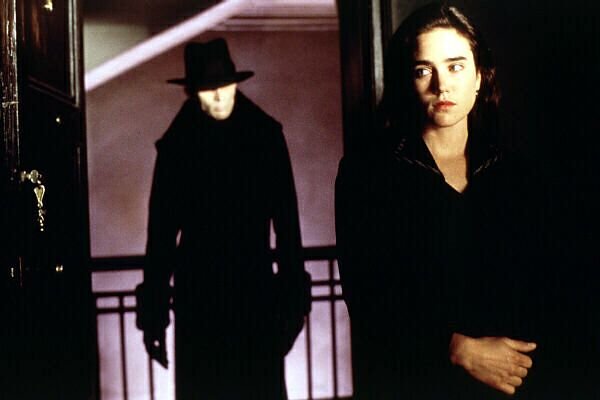
Last night I finally got around to watching Dark City (1999). Inexplicably, my first time seeing this 1998 picture. I had wanted to see it in the cinema (knowing Richard O'Brien was in it), but as memory serves it was one of a couple of films that year that seemed to get squeezed out of screening in Belfast between the long-running success of Titanic and the 1998 soccer world cup (typically an event during which a lot of cinemas avoided new releases back then). I'm not sure how or why it took me so long to finally see it, but there you go.

On the whole, I liked it very much. It does the noir look and feel so beautifully, I almost wish they'd filmed at least those sequences in black and white. The science fiction element is very well handled. In some ways it might be said to nod to similar themes as elements of The Matrix would deal with the following year. Dark City, however, tells its story in a much more intelligent way, without excessive effects being given the primary focus, and no need to weaken it with unnecessary sequels of diminishing quality. The 40s scenes are beautifully done, with the artificiality of the world being nicely nodded to with just the occasional shot of later anachronisms, like a line of sixties cars. Some of the feel of the picture actually remind me of Brazil; it has that same surrealist tone to it in the more science fiction sequences. Rufus Sewell as the lead sells his desperation and then growing confidence in his newly discovered abilities very well. Jennifer Connelly fits right in (as ever she did) as a convincing femme in the noir setting. Richard O'Brien as Mr Hand was also an excellent piece of casting. It's not a million miles away from his iconic Riff Raff, but toned down, wonderfully sinister. Kiefer Sutherland also inhabits the world beautifully. Significantly, those playing the humans all inhabit their 40s clothing wonderfully, which I think really helps to convince. None of them look like they're wearing a costume. You know when you see a guy a ta a wedding who clearly doesn't otherwise ever wear a suit doesn't like it, and just does look like he 'fits' all day? I've seen that a fair ew times in period-set films, but it's absent here.

It's probably not a picture for anyone who has no time for science fiction at all, but if a combination of scifi and neonoir setting wiggles your wire, it's well worth a view. A semi-forgotten classic kept alive by a cult reputation, certainly within the Rocky Horror community.
 

Forum statistics

Threads
114,740
Messages
3,181,346
Members
58,581
Latest member
MDz
Top