Want to buy or sell something? Check the classifieds
  • The Fedora Lounge is supported in part by commission earning affiliate links sitewide. Please support us by using them. You may learn more here.

What Was The Last Movie You Watched?

Doctor Strange

I'll Lock Up
Messages
5,283
Location
Hudson Valley, NY
Of course. It's a total mess. An incoherent mish-mosh thrown together by several writers and directors that doesn't fit together at all. A disappointing, yet fascinating, trainwreck.

That said, there are a couple of things I have always liked about it: Its jaunty, so-1960s musical score by Burt Bacharach (including the mega-hit song "The Look of Love"). And some of Woody Allen's classic line deliveries as "Jimmy Bond" are pretty funny (e.g., when threatened by a firing squad: "I have a low threshold of death! My doctor says it's very unhealthy...")
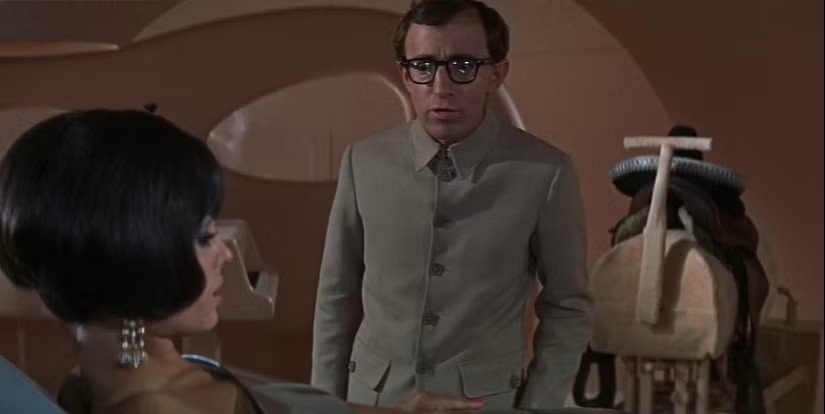
casino-royale-jimmy-bond.jpg
 

Edward

Bartender
Messages
26,355
Location
London, UK
Of course. It's a total mess. An incoherent mish-mosh thrown together by several writers and directors that doesn't fit together at all. A disappointing, yet fascinating, trainwreck.

That said, there are a couple of things I have always liked about it: Its jaunty, so-1960s musical score by Burt Bacharach (including the mega-hit song "The Look of Love"). And some of Woody Allen's classic line deliveries as "Jimmy Bond" are pretty funny (e.g., when threatened by a firing squad: "I have a low threshold of death! My doctor says it's very unhealthy...")

View attachment 752810


It's a fascinating curio, even if it does miss the mark somewhat. Has the feel of a first draft of what Austin Powers later did so much better, imo.
 
Messages
18,300
Location
New York City
MV5BMTg3NDg2OTE4MF5BMl5BanBnXkFtZTcwNDQ5MDQ2NA@@._V1_.jpg

One, Two, Three (1961) with James Cagney, Pamela Tiffin, Horst Buchholz, Liselotte Pulver, and Leon Askin


Billy Wilder and James Cagney teamed up for a movie that is so much better on screen than it sounds on paper that it's hard to do it justice in a review. Just know, the talent in One, Two, Three simply steamrolls over every plot stumble to succeed.

A farcical political satire with screwball and slapstick elements mixed in, set in West Germany during the Cold War and centering on the Coca-Cola company doesn't sound great, but in the hands of director/co-writer Wilder and lead Cagney, magic appears on the screen.

Well before This Is Spinal Tap, Wilder and Cagney (apparently they had "creative differences," but they made it all work anyway) produced a movie that ran at a breathless "eleven" pace and volume from the first scene to the last.

The plot is ridiculous: Cagney plays Coca-Cola's head man in Germany who wants to get promoted to head of all of Europe and relocate to London, but the CEO of Coke has just sent his cute, airhead seventeen-year-old party-girl daughter to stay with Cagney's family.

Another wrinkle has Cagney trying to negotiate a contract to get Coke into the USSR. Also, while she's staying with Cagney's family, the party-girl daughter, played by Pamela Tiffin, marries a combination beatnick and full-fledged, full-believing East German communist.

That's the setup that leads to Acts Two and Three, where Cagney has to "unwind" the marriage before his boss, Tiffin's father, comes over for a visit. Once Cagney miraculously does that, Tiffin announces she's pregnant, so Cagney has to put the marriage back together.

He also has to make the commie husband, played by Horst Buchholz, a respectable capitalist. Meanwhile, he has to save his own marriage, as his wife is threatening to take the kids back to the States. She's tired of living abroad and knows Cagney's been canoodling with his blonde secretary.

There are a few more minor side stories, but you get it: it's a circus, and Cagney is the ringmaster trying to bring control to the chaos, and that is where the fun in this one lies. It's all set against a backdrop of German discipline bending to Cagney's manic decision-making.

Be it Cagney barking orders to his heel-clicking German assistant, screaming for "Fritz" his chauffeur, or yelling at his office workers, who stand every time he enters the room, to "setzen machen!" – it's American brashness and confidence blasting through Teutonic order.

It's also just funny. Cagney and his happily s*xually loose blonde secretary playing off each other is a hilarious small storyline. There's so much here that you can't take it all in the first time you see it; there are just too many funny asides and "inside" jokes.

Cagney also makes fun of his own screen persona with a grapefruit-in-the-face joke echoing back to the famous scene in Public Enemy (1931), as does Red Buttons in a cameo riffing on Cagney's iconic 1930s tough-guy voice.

It's an incomplete list, but hat tips are owed to Tiffin, who wonderfully plays the daffy Southern belle; to Liselotte Pulver as the blithely prurient secretary: and to Leon Askin as the nervously yet mirthfully corrupt Soviet "trade representative."

If there's a weak spot it's Buchholz – a fine actor and a handsome young man – who made the mistake of trying to match Cagney's manic control of a scene. You can't out Cagney, Cagney; it just makes Buchholz sound loud and crass. The smart thing is to underplay against Cagney.

Almost everyone else got that and let Cagney be the loudest guy in the room, which left the lower-decibel bandwidths free for all the other talented actors to shine in – and other than Buchholz, they do.

Set in a divided city where East Germans were escaping to the West every day, there's plenty of contemporary politics in play. In Wilder's view, both sides are populated with hypocrites, but still, the people in the West live much better lives than the people in the East – hypocrisy or not.

There are scenes where you just marvel at Cagney's talent – like when he is, all at once and at warp speed, controlling his staff, ordering up haberdashers to attire Buchholz, planning with caterers a reception for his boss, trying to placate his wife, and doing a hundred other things.

One, Two, Three is Wilder and Cagney at their best. Wilder wrote manic humor and satire better than most and Cagney played it louder and better than most. They may not have seen eye to eye, but together their talents left us a gem in this satirical Cold War time capsule.


N.B. It's surprising that the Coca-Cola Company agreed to this movie. Coke isn't poorly represented here, but there is a snarky anti-big-business tone toward it and capitalism. Maybe Coke smartly saw the massive advertising opportunity and just said the heck to all the rest.

3zFOcd.gif
 
Messages
18,300
Location
New York City
the saint in london.jpeg

The Saint in London (1939) with George Sanders, Sally Gray, and David Burns


If you can, start with the Les Charteris books, not because they are Shakespearean, but because that is the best way to first experience the Saint. Then, you can take in the different film versions (several actors have played the Saint over the years) as fun interpretations.

None of that, though, is necessary to enjoy The Saint in London: the movie works well as a standalone effort. You can just sit back and watch the Saint as interpreted here by George Sanders.

For context, know that in the books, Charteris' creation is a wealthy, urbane man who enjoys solving mysteries while working just marginally on the right side of the law. He's the same on screen, in this movie in particular.

He's really like a more pleasant James Bond if Bond freelanced for the police or whatever government needed him for a one-off job. In this picture, Sanders, as the Saint, ends up covertly working with British Intelligence to investigate a small foreign criminal ring.

The plot doesn't really matter, but "the ring" is forcing a foreign embassy official to print a large sum of its currency, which the ring is going to steal. See, you don't really care about the plot – it's a MacGuffin – but you do care that Sanders is trying to stop the bad guys.

Forcing herself on the Saint – attractive women do that regularly – is a pretty, blonde socialite played by Sally Gray who likes the action and really likes the Saint. Sanders is busy trying to stop an international money-stealing ring, but like it or not, he has Gray along for the ride.

The ride, like in most Saint stories, is the Saint's investigation, which includes some breaking and entering (he crosses the same line the police used to back then), following clues, planting false clues for the bad guys, and generally being in the mix waiting for something to break.

It also includes a lot of head bonking (that's how you take your adversary out short of killing him in these movies), fist fights, a few knife and g*n fights, and a reasonable amount of chasing people around on foot or in cars – or just tying them up.

The real fun, though, is not all that action, but the smart, insouciant way the Saint goes about his investigation. He's smooth and polished – equally comfortable in high social circles or mixing it up with thugs – in a way that's a touch cocky, but not so much so that you dislike him.

Also in this one's mix is Sanders' "valet" and sidekick – a former pickpocket from New York, played by David Burns. He's the exact combination of loyalty, rough-edged street smart, and courage the Saint needs in a sidekick, plus he can iron a shirt and cook a meal.

Sanders is considered by many the gold standard of Saint interpretations. It helps that the actor is tall, handsome and British, all with an air of almost haughty elegance that fits the Saint's look and demeanor.

Today, Hollywood normally wants its men bending or about to bend a knee to some social issue or woman, but in the 1930s, Hollywood usually wanted its men to be physically imposing, handsome, impressively smart, independent, and a touch arrogant or aloof... like the Saint.

There is also a thread of mirth or comedy to the overall effort, as if Charteris is saying, "I'm letting you in on the joke, as this guy is just a bit too perfect; so enjoy him, but know this is a make-believe world."

Sally Gray is also in on the joke and has a ball being so. She's the secret ingredient that elevates this Saint movie above the others in the series. She's feisty, cute, courageous, and a touch silly, but never obnoxious or flighty. She's a cool girl, 1930s style, or really, in any era.

These Saint movies were serials B pictures for children and adults: kids liked the action adventures and adults enjoyed the stories and characters. They aren't challenging, but they are comfortable and intelligent enough to keep you lightly entertained.

The Saint is a man of his day – like the original Perry Mason, Raffles, or even the Thin Man, who are all cultural artifacts of roughly that same time. This only makes them more interesting to modern audiences looking for a window into the values of prewar 20th-century culture.

The Saint in London is a good window and a good movie. The books are really where you want to go to get a true feel for the man and his era, but if you just catch the movie, you're still seeing something of the 1930s zeitgeist, plus you get to look at a very pretty and fun Sally Gray.
 
Messages
14,398
Location
Germany
Think about all of the movies you've seen starring Arnold Schwarzenegger. Now think about the one you thought was the worst. The Running Man is far worse than that. Someone would have to pay ME before I'd watch it again, and even then I'd have to seriously consider it. I mean, I like Arnold and most of his movies. But this one is just...I don't know who thought it would be a good idea. Watch it if you really want to, but you've been forewarned.

Ha, but now that funnily brought back to my mind, what the most trashy movie was, that I ever saw. "Spiceworld" (Spice Girls), when I was 14.
If it would have been at least a little entertaining, but in the end it was just a waste of time. Sure, it was made for the girls. Luckily, I hadn't to pay for the cinema visit.
 
Last edited:
Messages
12,506
Location
Orange County, California
Ha, but now that funnily brought back to my mind, what the most trashy movie was, that I ever saw. "Spiceworld" (Spice Girls), when I was 14.
If it would have been at least a little entertaining, but in the end it was just a waste of time. Sure, it was made for the girls. Luckily, I hadn't to pay for the cinema visit.
There isn't enough money on the planet to pay ME to watch "Spice World".
 

Doctor Damage

I'll Lock Up
Messages
4,487
Location
Ontario
Last night I trudged through Phil Tippett's animated film "Mad God" (link below) which is a visual extravaganza and a must-see if you're super into stop-motion animation, etc. For everyone else, avoid. There's no discernible story or theme, and the tone changes dramatically at times, mixes in some live action (the worst scenes) and some nonsensical acid trip kaleidoscope scenes (pointless), and the ending is a dumb perpetual birth/death sort of allegory. The story description on Wikipedia is a thousand times more coherent than the film. Again, if you're into animation then some of the material is amazing, but the rest I mostly fast-forwarded through (and I can assure you I didn't miss anything even at 2x speed). You can tell it was done over several decades because there's a ton of visual inconsistency. Anyways.

https://en.wikipedia.org/wiki/Mad_God
 
Messages
18,300
Location
New York City
YouSaidAMouthful12.png

You Said a Mouthful from 1932 with Joe E. Brown, Allen "Farina" Hoskins, and Ginger Rogers


Joe E. Brown was a niche brand back in the early talkie days. It's hard to appreciate his far-out-there slapstick humor today, but he had a following in the Depression. For those who like, or at least can appreciate his style of humor, You Said a Mouthful is a representative offering.

Know, however, that you have left a world governed by the laws of physics when you move into Joe E. Brown's world where he can stay underwater for long stretches, get hit in the head with an anchor and be fine, and not know how to swim but compete at a professional level.

All those things and more happen in this formulaic – for Brown's crazy universe – story about a lowly shipping clerk who is picked on by his coworkers. When he's told he's inherited a large west coast estate, he quits his job, burns every bridge, and heads out to California.

It turns out that the estate is bankrupt. All Brown gets is a ward – a young black male child played by Allen "Farina" Hoskins. A little mistaken identity later (stock in trade for a Brown movie) and a young, pretty socialite, played by Ginger Rogers, thinks Brown is a marathon swimmer.

Brown and Hoskins are now staying at Rogers' parents' mansion as he prepares for the big swimming competition the following week, even though he doesn't know how to swim – something he's not going to tell swimmer groupie Rogers, whom he's already fallen hard for.

Toss in a rival swimmer, played by Preston Foster, and the framework is set for a bunch of Brown skits as he preps for the race: Brown water skiing by accident in a state of terror, Hoskins trying to teach him to swim in a harness with a garden hose, and other ridiculous little sketches.

Brown also courts Rogers, who needs no courting as she's all in on a star swimmer. Rounding out the plot without spoilers, the climax is the big race, which depends in part on Brown wearing an unsinkable swimming suit he invented, but which may not arrive in time for the competition.

The race is more Brown slapstick and shenanigans, as he accidentally grabs a fishing pole that has hooked a tuna, which, pulled by the tuna, has him passing the other swimmers. Later, a seaweed tangle near the end is just one more Brown contretemps that might cost him the race.

Believe it or not, these problems and stumbles are what you come for, if you choose to come to a Brown movie. He also regularly makes a long, piercing scream as part of his brand, which you'll either like – apparently many did back then – or find ungodly annoying.

Away from Brown, who plays fully on brand here, Rogers has reasonable screen time. Yet she doesn't do much with a tough role as she's basically a prop for Brown. Also, she's not particularly likable as she's only into him for the reflective glow of his status as a star swimmer.

The surprise here is Hoskins. If you bring a modern-day sensitivity meter, you'll scream racism and be done, but for the 1930s, Hoskins' character is refreshingly complex. He is a smart, perceptive child who, time and again, uses his intelligence to save Brown's hide.

Yes, he speaks in the insulting black dialect many movies forced on black characters then, but he's a good-natured kid who is the only character you'll both like and respect in this wacky movie. It's a relief when he's in a scene.

Stepping back, Charlie Chaplin and Groucho Marx, even today, still have an echo of cinematic currency, as to a lesser extent do Harold Lloyd and a few other slapstick stars of the era, but Joe E. Brown has fallen off the radar.

Perhaps it's because his brand is so h*rdcore and intentionally annoying that modern audiences simply don't want to see it. The other slapstick stars offered a lot of humanity – they often had a "laugh, clown, laugh" sadness to them – that doesn't come through in Joe E. Brown.

Brown is a blowhard who lies and brags obnoxiously. The kindest thing you could say about his character is that in the Depression he was a noisy, confident striver who took every blow sent his way and kept moving forward. Some, at that time of struggle, could likely identify with him.

Still, you don't find yourself rooting for him except in small bursts and until he does his next obnoxious thing. He is no "everyman" fighting for some dignity; he's more the annoying loudmouth loser you wish would just shut up.

All this makes his movies – movies including You Said a Mouthful – a tough slog for anyone other than a Joe E. Brown devotee.
 
Messages
18,300
Location
New York City
MV5BOWVlMGE0YzctMTBjZS00N2FhLThmN2QtMzY3MDhmY2RiMTRmXkEyXkFqcGc@._V1_.jpg

West of Broadway (1931) with John Gilbert, Lois Moran, Madge Evans, Frank Conroy, Ralph Bellamy, and El Brendel


One of the great mysteries of studio-era precode Hollywood is the number of incredibly talented actresses who never had the careers they should have. In West of Broadway, it's spitfire Lois Moran showing all the makings of a star who then left the business only one year later.

In Moran's case, she married an older and wealthier gentleman, so maybe retirement from Hollywood is what she wanted. Still, one can't watch her here – watch her sparkle in scenes with the charismatic John Gilbert – and not wonder about the career she could have had.

Standing five feet two, of which two or more are her out-of-control curly hair, it's not height and not even classic beauty – she is cute, though – it's screen personality that makes Moran shine.

It helps that she has a voice that can go from a sultry huskiness in the nightclub scenes to squeaky s*xiness when she attempts to win Gilbert over in Arizona.

MGM, here, put these two stars in a routine precode story about a jilted society man – presently drinking his sorrows away – marrying a poor "nobody," Moran, in a haze of depression and alcohol. Sober, he wants out, but she sincerely tries to make a go of the marriage.

The best version of this oft-used story is surprisingly an effort made under the Code with Bette Davis and Ian Hunter in The Girl from 10th Avenue (1935), but Moran and Gilbert give it a pretty good try here.

After Gilbert is honorably discharged from WWI (it's a bit confusing, but that's effectively what happens), he comes home to find his fiancée with another man. The woman he thought about all through the war has jilted him.

Out one night with an esc*rt, played by Moran, Gilbert sees his former fiancée, now engaged to another man – the man who stole her from him. As those emotions swirl and having consumed too much alcohol, Gilbert – not thinking straight – proposes to Moran.

Despite Moran's protestations, they marry that night. But Gilbert, as noted, immediately wants out, so he offers Moran a large settlement to divorce him. He then heads to his Arizona ranch because his doctor says he needs the air out there for his health – he was gassed in the war.

Moran, who is not in it for the money, soon shows up in Arizona trying to be a good wife and help nurse Gilbert back to health, but he's too stubborn and cynical to see that she's sincere. He's often brutally abusive to her, but she tries hard to make their marriage work.

The movie has the same basic ending as all these types of tales do, but it's handled okay here – despite being rushed as so many precode climaxes are. For some reason, back then, directors seemed to want to get the ending over with as quickly as possible,

Gilbert's talking-era woes have been well documented – studio boss Louis B. Mayer had it in for him, alcohol didn't help, and his voice wasn't good for the talkies (the last is complete nonsense) – but on screen, here, the silent-era legend is handsome, engaging, and natural.

It's Moran, though, who gives the movie its kick. She's a small ball of energy, confidence, and adorable s*xiness. You believe she loves Gilbert, isn't a gold-digger, wants the marriage to work, and is willing to take a lot of abuse to push through to her goal. It's an impressive performance.

Madge Evans as the cold fiancée, Frank Conroy as Gilbert's good friend and lawyer (Gilbert is a man who needs a full-time lawyer), a young Ralph Bellamy as the Arizona ranch foreman, and El Brendel as Gilbert's army buddy (and the movie's comic relief) round out a talent-rich cast.

West of Broadway has a retread story, clunky production qualities, and sloppy transitions and continuity, but Gilbert and Moran – Moran in particular – deliver performances that are moving and sincere, which makes it still engaging viewing, nearly a century on.
 

LizzieMaine

Bartender
Messages
35,540
Location
Where The Tourists Meet The Sea
The surprise here is Hoskins. If you bring a modern-day sensitivity meter, you'll scream racism and be done, but for the 1930s, Hoskins' character is refreshingly complex. He is a smart, perceptive child who, time and again, uses his intelligence to save Brown's hide.

Yes, he speaks in the insulting black dialect many movies forced on black characters then, but he's a good-natured kid who is the only character you'll both like and respect in this wacky movie. It's a relief when he's in a scene.
Hoskins was best known as the longest running star of the "Our Gang" comedies, in which he started when he hadn't yet turned two. He literally grew up on the Hal Roach lot, surrounded by some of the sharpest comedy minds of the 1920s, but somewhere along the way he also learned to really *act.*

There is a 1931 "Our Gang" comedy called "Little Daddy" in which he and "Stymie" Beard (five years old at the time) play orphaned brothers living on their own in a shack, and Hoskins is absolutely wonderful in this. He gets his laughs, he breaks your heart, and you root for him for the whole two reels. This one rarely turns up in "Little Rascals" retrospectives because of the perceived stereotyping, but in fact both kids, but "Farina" especially, carry their roles with dignity.


Hoskins eventually quit show business because in his own words he "wanted to eat regularly," and went on to a long and notable career working with the disabled. He ought to be far better remembered than he is.
 
Messages
18,300
Location
New York City
MV5BMTk0OTM0MTkwMF5BMl5BanBnXkFtZTgwMjA2MjgwMjE@._V1_.jpg

Alexander Hamilton (1931) with George Arliss, June Collyer, Doris Kenyon, Dudley Digges, and Montague Love


You do not come to this 1931 movie for a portrayal of the history, the politics, or the personal life of Alexander Hamilton writ accurately; you come to see George Arliss – a huge star at the time – play a 1930s Hollywood-created version of Hamilton with some "truthiness."

The resulting movie, Alexander Hamilton, is interesting in a curio sort of way. However, instead of taking advantage of the precode to show Hamilton's famous affair, the relationship seems chaste until Arliss as Hamilton admits that it was, well, bow chicka wow wow.

It's hard to picture talented but miscast Arliss in his sixties playing handsome Hamilton in his thirties, having an affair – as no one, not even Arliss himself, can imagine him sleeping with a pretty young woman. This is a rare time where Hollywood undid the s*x appeal of a character.

All the above is necessary to understanding the movie where Arliss as Hamilton – the Secretary of the Treasury – works assiduously to pass a few bills for the good of the nation. Yet he is nearly undone by his personal libidinous failings. Thankfully, that never happened to the nation again.

Hamilton's paramour's husband blackmails Hamilton over the affair, which Hamilton pays. Later, the records of those payments are used to argue Hamilton acted corruptly in his official capacity as Treasurer – which he did not.

Since the passing of the bills is part of the historical record, it's hardly a spoiler to say what happened and, in broad strokes, the movie gets it right that Hamilton puts his personal shortcomings (longcomings?) on display to successfully dispute the charges of corruption.

Even though the bills passed, Hamilton's aspirations for the White House ended there. Yet even more fame would come Hamilton's way when he fought his infamous duel with Aaron Burr. Today, instead of a duel, they'd just say mean things about each other on social media.

Be prepared for a lot of scenes of men in a room talking to each other about politics, not that the action picks up when the women enter as they just sit around and talk too. Since the point is Hamilton hagiography, the dialogue and story is hardly scintillating.

All this adds up to a dated feel, which makes the film a heavy lift for modern audiences. It's basically a filmed stage play where the actors almost all seem to be stilted and overacting – even Arliss – as that was the style of theater acting at the time.

Dudley Digges, playing the evil Senator Roberts, does everything short of twirling his mustache, and Montague Love plays Thomas Jefferson as if every line he says is being added to the Declaration of Independence. The only subtlety in this one comes from the women.

June Collyer is quite good as the paramour, possibly because she never was a theater actor. Doris Kenyon, as the wronged wife, plays down her theatrical mannerisms giving her scenes some relief from the acting affectations.

The writing, too, is obvious. Even if you don't know the historical outline, most plot twists are advertised well in advance, so you're not watching anxiously, but you feel more like a kid being told a bedtime story – look for your accurate and detailed history elsewhere.

Still, as biopics from the era go, Alexander Hamilton is okay if you can get into the spirit of it or if you like George Arliss, who had a run in biopics back then. It's a throwback style – it was even a bit of a throwback style in 1931 – so you either go with it, or watch another movie.
 

Harp

I'll Lock Up
Messages
9,017
Location
Chicago, IL US
^ Hamilton is the best Publius. A lousy ****** marksman, but a great strict constructionist who
grasped the need for exactitude in legal and moral reasoning. Of particular note is his stance on the
concomitant right to silence. :)
 
Messages
18,300
Location
New York City
^ Hamilton is the best Publius. A lousy ****** marksman, but a great strict constructionist who
grasped the need for exactitude in legal and moral reasoning. Of particular note is his stance on the
concomitant right to silence. :)

I still say Acela's quiet car was one of the greatest advancement in train travel in the past fifty years.
 

Forum statistics

Threads
114,741
Messages
3,181,388
Members
58,581
Latest member
MDz
Top