Want to buy or sell something? Check the classifieds
  • The Fedora Lounge is supported in part by commission earning affiliate links sitewide. Please support us by using them. You may learn more here.

What Was The Last Movie You Watched?

Messages
18,301
Location
New York City
always a bride.jpeg

Always a Bride from 1953 with Ronald Squire, ****y ***mins, and Terence Morgan


This pleasant little English comedy works because it neither takes itself too seriously nor descends into farce; instead, Always a Bride ambles along languidly as a charming father-daughter confidence team **** their way through the better hotels and resorts of Europe.

Ronald Squire and ****y ***mins play the father-daughter team who swindle luxury hotel guests, then move on. Since it's a movie, and they're nicely mannered crooks whose marks are the idle rich, we never get too worked up about the morality of it.

Squire even accepts that sometimes he'll fail and be broke or sent – again – to prison; it's just his way of life. But daughter ***mins, especially after she meets a nice, honest man, played by Terence Morgan, begins to question their, umm, "lifestyle."

The main plot has the police somewhat on the duo's trail, so they have to keep moving. But the plot within a plot has the two ****mers, along with a few other crooked pals, trying to pull off an even bigger **** – using fake deeds to sell a luxury hotel to a millionaire businessman.

A big part of the fun here is the tone – the playful way the crooks see their business. Squire ****s – yes for the money – but also for the challenge and joy of not making money in an honest way. It's not mean-spirited; it's just that they see themselves, with pride, as a kind of professional.

***mins is the outlier, less because of her conscience and more due to a desire to live a normal life, as the ****mer's life is an exhausting one of always being on, always playing a part, always worrying, and never being yourself except in private.

All this plays out with such a lighthearted tone that half the time you're rooting for Squire, ***mins, and their team to get away with their ****s, as you don't want to see them – spirit broken – in a prison. It's movie morality suspending real-world morality.

It helps, too, that everything looks so pretty. Filmed on location in Monaco and Nice – with everyone dressed to the nines and polite in that English/European mid-century monied way – it's practically a travelogue for post-war Europe.

Eventually, the threads – the circling police, the pair's regular hotel ****, ***mins' budding love affair with Morgan, and the big **** of "selling" the hotel – come together in a cheeky climax that has you smiling, even though not everything works out perfectly for all the crooks.

None of this would have worked if not for Squire – an actor born to play an urbane conman with such flair that, darn it, you like him. ***mins, showing some range away from her defining film noir role in *** Crazy (1950), is engaging as the nonplussed daughter trying to change her life.

Along with a collection of supporting actors who understood the joie de vivre of the movie, director Ralph Smart kept things moving at a fast pace and ended the lighthearted film before its thin plot and charm had a chance to overstay their welcome.

Fans of Alec Guinness movies from this era will appreciate Always a Bride because it shares the same spirit of poking fun at British class prejudice as many of Guinness' pictures did. After all, Squire is only successful at ****ming because he's perceived as a "gentleman."

Always a Bride lets you in on its playful wink with its likable cast of harmless scoundrels. It's not groundbreaking or even particularly memorable, but it is entertaining in its flippantly fun manner – which isn't a bad way to spend eighty minutes.
 
Messages
18,301
Location
New York City
vr032.jpg

Von Ryan's Express from 1965 with Frank Sinatra and Trevor Howard


Some movies do it all: complex characters, intricate plotting, and engaging action scenes – with a holistic thematic overlay that has you thinking about the movie long after you see it. Others say "to heck with all that," and just try to do one or two things well.

Von Ryan's Express is in the latter camp. Its characters are archetypes and its plotting is riddled with holes, but it has some ripping-good action scenes, personal confrontations, and, well, the theme of handing out a beat-down to the Germany's WWII-era leaderships isn't original, but it never gets old.

Frank Sinatra plays an American Air Force colonel who is shot down in Italy and brought to an Italian POW camp full of Brits. Sinatra outranks the camp's current senior officer, played with British war-time fanaticism by Trevor Howard.

Sinatra's war-weary but compassionate pragmatism clashes with Howard's "I'm all soldier" dogma, leading to a movie-long rub that – of course – turns into grudging mutual respect as each sees the integrity of the other over time, even if they never fully agree on strategy.

Before all that, though, a bunch of things have to happen in this long movie – the Italians surrender the camp; the Germans retake it; Sinatra leads an escape, the men get recaptured and put on a German prisoner train headed, one assumes, to a German POW camp.

Now stuck as prisoners on the train, Sinatra and Howard finally start to truly work together to figure out a way to take over the train, which they do in a darn fine scene of strangling or tossing a bunch of German guards off the moving train and then taking over the train's cab.

The thing about a train, though, as wonderful a means of transportation as it is, is you can take it over, but you're still on a track going one way. So initially, Sinatra and team are escaping in the wrong direction.

After a bunch of close calls when the Germans nearly retake the train, the team hits on a plan to take an old rail line through the Alps into Switzerland. Sounds good, but a German troop train is hot on their trail and several Messerschmitts loom overhead.

It's a good action-adventure movie all along, but when the escape train gets to the Alps and it's whipping through some incredibly beautiful scenery of mountain tunnels and bridges with those Messerschmitts attempting to bomb it, the movie soars above any modern CGI effort.

Some serious effort went into filming this level of believability in 1965. That's what CGI killed – the meta-movie experience of enjoying a scene and wondering, "How'd they do that?" because now we all know how they did it and don't care because there's no meta wow factor to CGI.

Beyond the excellent action scenes, some of the personal confrontation scenes – despite often being cliches – are good. Sinatra's fatigued but dedicated approach contrasts perfectly with Howard's hyper militarism – it's a relationship that could have been spun off into a TV show.

You'll also want to watch for Edward Mulhare as the British chaplain who speaks German. He is asked by Sinatra to impersonate a German officer to get the train through a checkpoint. He doesn't want to, but once he's "live," he starts to embrace the role – it's smart, nuanced humor.

The other character to look for is Sergio Fantoni playing an Italian officer who segues from being a senior officer in the POW camp to Sinatra's aid during the long escape. Despite Howard never fully trusting him, Fantoni conveys integrity that has the viewer with him all along.

By the 1960s, WWII was fodder for these fictional action-adventure tales that populated the screen for the next decade-plus until Vietnam made Americans want something else from their war movies - and it wasn't rah-rah patriotism.

Von Ryan's Express is a fun throwback that doesn't expand the borders of its genre, but it entertains like all heck, which isn't a bad achievement for a WWII action-adventure movie.
 
Messages
18,301
Location
New York City
MV5BMjIwOTI3NjY5MV5BMl5BanBnXkFtZTgwNDk3OTc5MTE@._V1_.jpg

Cruel Story of Youth from 1960, a Japanese film


There is a through line from mid-century American teenage rebel movies – Dean and Brando – and England's rebellious kitchen sink dramas – Finney and Burton – to Cruel Story of Youth, but this Japanese version of youth going off the rails is much darker.

A bored middle-class teenage Japanese girl – Makoto – meets a low-life grifter/gigolo – Kiyoshi – and not one good thing follows. Their first-date ***ual encounter would qualify as date **** today, but Makoto comes back for more. She even wants him more than he wants her.

She wants to turn their "quickie" into a relationship, but disaffected, dirty, and corrupt Kiyoshi would rather move on – for no other reason than that nothing means anything to him. But Makoto, clearly lacking – in today's terms – an ounce of self-esteem, hangs in there.

Soon, she's the bait in a low-rent extortion **** Kiyoshi runs where Makoto solicits herself to prosperous-looking older men and then, later, Kiyoshi shakes them down for money so he won't expose what they did to their family or the police.

All this happens in a filthy and violent gang world of drinking, smoking, sleeping around, vicious fighting, and grifting – a world Kiyoshi may have a reason for being in, but Makoto could always return to the open arms of her normal middle-class sister and father.

For Makoto and, at times, Kiyoshi, it is love that draws them together – raising the question of why Makoto would love a man who is so abusive toward her. He often ignores her or slaps her around. We think we know the answer in today's terms, but still it's awful to watch.

There is of course a climax – sloppy, brazen criminals don't retire from old age – but it just puts an exclamation point on a movie that says all along: something is very wrong here.

For a sense of proportion, we need the sociologists to tell us how big a problem this was in mid-century Japan as the country was rapidly improving economically at this point. It offered a lot of opportunity to the young who wanted to conform and participate.

Just like in the wealthier West at that time, however, not all the youth wanted to conform – so they rode motorcycles, screamed about being torn apart, drank themselves into oblivion on Saturday night, and, in general, raised a middle finger to middle-class values.

What is going on in Cruel Story of Youth is an extreme version of this defiance where the youthful rebellion has no purpose, no context, no politics – it's just raw anger that lashes out. It makes for harsh viewing.

Director Nagisa Ôshima shot his gruesome look at Japan's youth in color, so this is no grainy black-and-white window into a grimy world, but a full-burst-of-color view of a grimy world that brings it frighteningly close to the viewer.

You can decide if the sometimes awkward transitions and lingering shots on the background provide "artsy" time to reflect or are a hand raised in support of better editing, as the movie loses some energy from repetition in the middle.

The acting, too, feels uneven, as Makoto often “blank-stares” her way through a scene. But still, you'll find yourself engaged with the character as she slowly transitions into being a genuine criminal who justifies her actions with the trite “the ‘honest’ people cheat too” defense.

Wanton ***, ****, prostitution, ********, and extortion are all treated as facts of life in this brutal look at the underbelly of Japan. It's true, but so are the good stories of young people going to school, getting jobs, and building Japan into a 1980s economic ****ernaut.

To this day, despite many, many efforts, no one has solved the (unsolvable) problem of disaffected youth, but few in 1960 were showing it in such raw terms as Cruel Story of Youth – an extreme version of the youth rebellion sweeping the cinematic world at the time.
 

Doctor Damage

I'll Lock Up
Messages
4,487
Location
Ontario
Last night I watched Steven Soderburgh's "Kimi" starring Zoe Kravitz as a young woman working remotely for a tech firm troubleshooting their products who accidentally hears a violent confrontation recorded by one of the firm's devices. It borrows heavily from the Gene Hackman classic "The Conversation" but in a modern world. Nothing deep, nothing that can withstand a serious interrogation of the story, but just a solid well made film like much of Soderburgh'st stuff.
 

Levallois

Practically Family
Messages
580
Ronin 1998 - what a great movie - stellar cast, script and director - hadn’t seen it in a while - fantastic! Put a post over in “Show us your firearms“ regarding this movie too.

“You ever kill anybody? I hurt someone’s feelings once.”
”You think too hard. Nobody ever told me that before”
 
Last edited:
Messages
18,301
Location
New York City
MV5BODA4ODEyY2UtMmUzZC00NjM0LTgzNmEtNGJjY2ZlNTAwYTU2XkEyXkFqcGc@._V1_.jpg

A Passport to Hell from 1932 with Elissa Landi, Paul Lukas, Warner Oland, and Alexander Kirkland


Moral ambiguity, courage, honor, and Elissa Landi make a potent combination in A Passport to Hell, an engaging precode set at the start of WWI. Our morality today is so me focused and squishy that movies like this can't be made, as we have no cultural frame of reference for them.

In 1932, however, there was an aspirational moral code that had some people sacrificing for others in gloriously romantic or honor-bound ways. It starts here with Landi playing a stock precode character: the pretty, wanton woman who has been "asked to leave" several countries.

Persona non grata in England proper, Landi is living in an English colony in Africa, where a man she's connected with commits *******. Although she wasn't present at the *******, because of her relationship with him, she's shipped off to a German colony in Africa.

The German commander there, played with Teutonic sternness by Warner Oland, immediately senses trouble and orders her shipped out on the next boat. But Oland's son, a junior officer played by Alexander Kirkland, immediately falls in love with the blonde and beautiful Landi.

With WWI looming and Kirkland knowing Landi will be cast adrift, he marries her on the spot to give her the protection of his name. Dad (Oland) is not pleased, so he cuts his son off financially, hoping to break the marriage, as he assumes Landi won't endure a frugal existence.

The movie now echoes another powerful precode film (based on a W. Somerset Maugham novel), 1934's The Painted Veil, as Landi finds herself married to a man out of necessity rather than love and stuck living in an African colonial outpost without luxury or friends.

Enter, of course, a handsome friend of Landi's, played by Paul Lukas, appearing – naturally – while Kirkland is away on military maneuvers, to stir the pot. You can guess what happens now, but the fall-out from it is pretty dramatic.

In fifteen minutes of screen time, no fewer than three dramatically selfless sacrifices are attempted, along with one *******, one stirring act of contrition, and – ultimately, as the credits roll – no one getting what they truly want.

Landi proves worthy of the material as a blonde beauty whose God-given presence declares, "I can take it." She's no damsel in distress, but a fiercely resolute woman. It's an outstanding performance from an actress in complete control of the material and her talent.

Look for the scene in which she has a chance to save herself but chooses to save her husband. With few words, Landi expresses thought, courage, fortitude, and necessary feints. It's outstanding acting in service to a morality and romanticism we don't even understand today.

Today we encourage people to live out loud, believing expressing every emotion is somehow helpful and empowering. This, however, was an era where controlling one's emotions and keeping one's own counsel were lauded.

Landi's quiet sacrifice, where you see her conceal her pain – she gets control of her facial expression before leaving the privacy of her room to face the consequences of her decision – is period perfect. Her composure in public stands in stark contrast to today's often loud public drama.

Lukas gives his usual thoughtful performance, but you also have to note Oland, who ticks along for most of the movie playing the cookie-cutter formidable German father and officer, only to show a believable change when the ground beneath his feet permanently shifts.

A Passport to Hell comes from an era when honor, moral codes, and one's reputation truly and deeply meant something. All of that is powerfully on display here in a tight story that rips along to a nail-biting, very precode conclusion.
 

Doctor Damage

I'll Lock Up
Messages
4,487
Location
Ontario
Ronin 1998 - what a great movie - stellar cast, script and director - hadn’t seen it in a while - fantastic! Put a post over in “Show us your firearms“ regarding this movie too.

“You ever kill anybody? I hurt someone’s feelings once.”
”You think too hard. Nobody ever told me that before”
I had forgotten about that film despite loving it and seeing it a half dozen times. Nice to see the always rare MB 6.9 being driven in one scene.

Here's a useful guide to the firearms used in the film:
https://www.imfdb.org/wiki/Ronin
 
Messages
18,301
Location
New York City
cheap-1200-1200-675-675-crop-000000.jpg

The Cheap Detective from 1978


If only Neil Simon didn't try to tell three not-funny jokes to every funny one, The Cheap Detective would be an outstanding send up of Humphrey Bogart's hard-boiled 1940s persona, Casablanca, The Maltese Falcon, and film noir in general. Still, there's much to like here.

The thing to like the most is Peter Falk playing an exaggerated riff on Bogey – lisp, awkward walk, and his weary shrug. But it's not a pure impression; it's more of a teasing homage to the iconic actor.

Set in the 1940s in San Francisco and styled right out of that era's film noir movies, it has a reasonably good period feel for a picture made in the 1970s. But being a Neil Simon-written movie, there's more parody than accuracy – more tongue-in-cheek humor than story you can follow.

It's rare to say that the story doesn't matter much in a movie, but it doesn't: you come to this picture as a fan of those old movies or you're in the wrong theater. You come for the send-up, the nostalgia, and all the stars in small roles or cameos.

The "plot" has Falk playing a Bogey-like detective involved in a blended Casablanca and The Maltese Falcon story with elements of other noirs, like The Big Sleep, tossed in for fun. You can't really follow it (can you really follow half the original noirs that well?) and you don't care.

You get it at a high level – Falk is trying to find some historically important missing diamonds (a black bird doppelgänger) while helping the woman he loved – who deserted him – escape with her husband from the Germany's WWII-era leaderships. If you try to tick and tie every plot twist, you're doing it wrong.

What you care about is how funny Falk is slant rhyming Bogey / John Houseman is slant rhyming Sydney Greenstreet / Dom DeLuise is slant rhyming Peter Lorre / Louise Fletcher is slant rhyming Ingrid Bergman / and Madeline Kahn is slant rhyming Mary Astor.

You'll enjoy, too, Ann-Margret's intentionally exaggerated gold-digger ***-kitten wife act, Stockard Channing playing Falk's/Bogey's loyal secretary, and Vic Tayback as the stock smart-but-exhausted senior-detective character who likes Falk even if most of his policemen don't.

You'll love the parody when it lands well, as it does in a few scenes when Falk has to ****le an insane number of women coming onto him at the same time. It also lands beautifully in a take on The Maltese Falcon scene in which all the principals think they've finally found the bird.

There are, however, a lot of scenes that try too hard to be funny and fall flat and, of course, the aforementioned telling of way too many jokes that aren't funny, which diminishes the ones that are. At its weakest moments, the entire effort feels a bit like a Catskills skit.

It does, though, have this going for it: it's a better parody of film noir than Steve Martin's slapstick-laden effort in Dead Men Don't Wear Plaid (1982), which has its moments, too, but often forgets that it's a parody and not a Steve Martin stand-up comedy routine.

Too many jokes that don't land and a plot built to be ignored don't help this Bogey/film-noir sendup – but that was Neil Simon's style. Still, The Cheap Detective lands enough jokes, has enough funny riffs, and enough stars to make it worth the watch for old movie fans.

With the respect most filmmakers have today for period details, perhaps the time is right for Hollywood to produce another round of film noir sendup movies. The problem is there may be too few modern viewers who have seen the original noirs to appreciate a contemporary parody.
 
Messages
18,301
Location
New York City
The-World-Changes-1933-film.jpg

The World Changes from 1933 with Paul Muni, Mary Astor, Aline MacMahon, Guy Kibbie, Jean Muir, Donald Cook, Margaret Lindsay, and Patricia Ellis


Every generation has its family-saga business epics – its "rags-to-riches business empire building, followed by generational strife" tales. The World Changes is a fairly typical representation of an early 20th-century American version of this story.

Back then, a singular man – it almost always was a man – would start out poor, but with raw ambition, grit, hard work, luck, risk, and kismet, he'd turn a skill, an idea, an invention, or a discovery into a business empire. Then the real struggles began.

Here, Paul Muni plays the son of immigrant Midwest farmers, but he sees an opportunity to be the first to herd cattle from Texas to Chicago, where they are then shipped across the country. After much work, risk, luck, and battle, he becomes a "meatpacking king."

Had the movie stopped here, it would be a good Horatio Alger tale, but it's only the end of Act One, for now the real challenges set in. Muni's wife, played by Mary Astor – the daughter of a meatpacking king herself – having attended east coast finishing schools, hates the business.

It takes audacity to hate the business that provides you with incredible wealth and to hate the men – your father or husband – who run it, but it's a common tale. Here the rub for Astor is that "meatpacking" has a literal and social "stink" that works against climbing in "high society."

Now the family metaphorically splits as Astor raises their two sons to be "gentlemen," while Muni tries but eventually gives up on turning them into hard-working businessmen. One tragedy later and the family has decamped to New York City in Act Two.

Muni buys one son a brokerage firm, while the other he simply supports as a society "*******." Eventually, "Grampa" Muni is shuffled aside – although everyone takes his money – as the family becomes part of the outer edge of New York's upper crust: rich, proper, and useless.

Muni sees it all, but says little until the stock market crash of 1929 brings everything to a climax in Act Three. Now, director Mervyn Leroy lets rip with the lessons and homilies a country struggling through the Great Depression wanted to hear about Wall Street greed.

It's a good "epic," even if the story is an inaccurate and oversimplified boilerplate. Yes, Wall Street has its share of the blame, but it's also the capital markets Wall Street built that allowed the country to industrialize so rapidly and successfully. Few stories are black and white.

The actors, too, are stuffed into roles that are more archetypal than fully developed characters. Muni is the most well-rounded of them, though, in part because of his talent. He, however, has to move through so much history and story, that he becomes a bit of a caricature.

Astor also plays a bit of a cliché as the ingrate daughter and wife, but like Muni, she brings some genuine personality to the role – as does Aline MacMahon in her role as Muni's mother. Watch for MacMahon's scenes at the end to see some outstanding acting at work.

The rest of the large cast, which includes Guy Kibbie, Jean Muir, Donald Cook, Margaret Lindsay, and Patricia Ellis, is mainly from Warner Bros.' impressive stable. It is a strong talent pool that allows the movie to shuffle over its plot flaws and rapid run through history.

Director Leroy had a herculean task corralling his sizable cast and sprawling multigenerational story to the screen, and for the most part, he succeeds. However, a few transitions – as when the family moves to New York – are jarring. Still, he got the job done reasonably well.

The World Changes is not a great movie, but it is entertaining. It is also a good example of its type: the one-man empire builder who forges a company out of his iron will, but isn't able to pass on that skill, drive, and passion on to the next generation.

The true story of the industrialization of America and of the men (and the few women) who built great empires is much more complex – sometimes the second or third generation took the business to greater heights.

The film, though, simplifies history into a characterization, as in the Depression, nothing sold better than a morality play that faulted business, Wall Street, rich people, and greed.
 
Messages
18,301
Location
New York City
MV5BOGQzMjRiMzQtNTJjNy00MjJmLWExOGEtZDk5MWRlNGVjOTdlXkEyXkFqcGc@._V1_FMjpg_UX704_.jpg

Hard to Get from 1938 with Olivia de Havilland, **** Powell, Charles Winninger, Melville Cooper, and Bonita Granville


The incredible influence the seminal road-trip romcom blockbuster It Happened One Night (1934) has had on Hollywood cannot be exaggerated. Even to this day, it drives plots and stories in movies and TV shows.

Back in the 1930s and 1940s, though, it could feel as if every third A or B picture was trying to slipstream the genre-defining megahit. Hard to Get from Warner Bros. is just another one of the blockbuster's B-movie pilot fish, but a surprisingly fun one if you are a bit forgiving.

Olivia de Havilland, never looking cuter in her adorable rich-girl "fun" clothes outfits, plays a version of the somewhat spoiled, somewhat daffy, but really nice – and smarter than she seems – heiress whom Claudette Colbert played in It Happened One Night.

De Havilland doesn't go on a road trip like Colbert, however, she just drives into the new nearby gas station and falls hard for the attractive attendant, played by **** Powell. Powell – with the Depression in full flourish – is a college-educated architect unable to find work in his field.

They meet cute and immediately shift to flirt-fighting – the romcom's defining move – with a heavy emphasis on fighting. Later, they make up, start dating, and plot a way for Powell to get his idea for a chain of motor courts in front of De Havilland's wacky but successful businessman father.

As in all of these romcoms, there are several side stories filling the time between De Havilland and Powell's romance. The best of the three here has De Havilland's father, played by Charles Winninger, always betting his valet, played by Melville Cooper, on one-on-one competitions.

The fun here is Cooper's uber-dry deadpan as he wins one bet after another, but manages to display humor and affection toward his employer, while Winninger's frustration at always losing is funny, a bit silly, but never mean spirited. These two have wonderful chemistry.

The other two side stories are much less enjoyable. The first one involves Winninger and a business peer bouncing Powell around as Powell tries – with De Havilland covertly helping – to pitch his business plan. It becomes too screwball, too repetitive, and too mean.

The last thread has De Havilland's mother and sister, the latter played by uber-adorable Bonita Granville, playing the family snobs who can't fathom De Havilland marrying a lowly gas station jockey. Fortunately, this – even in 1938 – tired storyline is relegated to a background role.

If you don't know what is going to happen from the first ten minutes of this movie, then you've never seen a romcom. The fun in these is never the half-screwy, obvious plot; the fun is the on-screen chemistry the two leads have and here it's just okay.

Fortunately, De Havilland has enough cuteness and spirit on her own to carry Powell, who's fine but not electric, along. It helps greatly that De Havilland and Winninger have a lot of on-screen chemistry as do Winninger and Cooper.

All it takes to elevate the movie are a few good scenes, like the one of a proud De Havilland breaking down in front of her dad over her love for Powell, while he helps pull her through. It's the father-daughter relationship every father and daughter hope for.

Hard to Get is no It Happened One Night, but it wasn't really trying to be. It was trying to be a fun, low-budget echo, and it succeeds – mainly because of De Havilland, but with a hat tip to Winninger and Cooper.

MV5BYjEwMjM1ZWQtZWIwNC00MTY3LWE0ZDItNGE1ZGU0NTcyNjliXkEyXkFqcGdeQWRpZWdtb25n._V1_QL75_UX500_CR...jpg
 
Messages
18,301
Location
New York City
dividedheart05.jpg

The Divided Heart from 1954


When a war is over, there is a lot to clean up and make right, but that is often impossible. In The Divided Heart, a post-WWII American three-judge panel is facing one of those impossible tasks when it has to decide between an orphan boy's adoptive parents and his birth mother.

Born to Yugoslavian parents during WWII – and when still a baby – Toni's father is executed by the Germany's WWII-era leaderships for being a partisan, and his mother is sent to a concentration camp. Toni is then legally (at the time, under Germany's WWII-era leadership law) adopted by German parents.

It is now ten years later; Toni's mother survived the camp and – through an agency charged with reuniting families – has come to Germany to reclaim her son. Toni is her only relative who survived the conflict, as her two daughters were killed in the war.

The German parents are good, hard-working, honest people who deeply love their son, whom they've raised as their own since he was a baby. Their homelife is Alps idyllic, which has our sympathies all aligned with them at the start.

The Yugoslavian mother – who's lived through a hell few of us can even genuinely imagine – seems cold, so while we can intellectually feel for her, we don't want poor Toni taken from his happy home to live in a foreign country with a woman he doesn't know.

That's the setup, but as the movie unfolds in Act Two – with the birth mother allowed to spend time with Toni – we see that she is a good woman trying hard to get a part of her old life back. She's a mother who wants her son; framed that way, our sympathies become a cat's cradle.

Act Three, perforce, plays out in the courtroom, and it's gut wrenching as there are no good choices: take the boy from the only parents and country he knows (and loves) or deny a Holocaust survivor her only living relative – her son.

After spending considerable time in the beautiful Alps, the courtroom feels cold, analytical, and the wrong place to decide a very human problem. Yet here we are, with the birth mother at one table, the German parents at another, and Toni's fate hanging in the balance.

The power and moral clarity in this heartbreaking tale is reflected in the honest way it is told. The German parents are frightened and have some stupid thoughts, as we all do in crisis, but throughout they do the right thing even as it kills them emotionally.

The Yugoslavian mother softens, too, as she sees that the German parents are good people and she'd be breaking up a happy home if she forces her legal claim. There are no good answers here.

Stuck in the middle is poor Toni who seems to understand what is going on, but how can a ten-year-old have the perspective to process the complexity of all the nuances, competing claims, and compelling issues buffeting this case?

Shot in black and white, on-location in Austria, the realism of the picture – based on a true story – is enhanced by the unadorned but professional filmmaking filmmaking of England's fabled Ealing Studios.

Also enhancing the realism are the fine performances by Cornell Borchers as the German mother – an actress once billed as "the next Ingrid Bergman" (it didn't work out that way) – and Yvonne Mitchell, delivering a compelling portrayal of the boy's Yugoslavian mother.

The Divided Heart is storytelling on film at its best: no action adventure, no special effects, no fancy anything, just solid production qualities, solid direction by Charles Crichton, and solid acting. It's a smart, "small" movie that sneaks up on you in the best way possible.
 

DogFacePonySoldier

One of the Regulars
Messages
164
May watch the Sodaberg flick I like Gene Hackman in the Conversation and the French Connection.

Ronin kicks *** I still remember it having one of the best car chase scenes.

Last movie I seen was Mindhunter 1986, Brian Cox stood out as Lecter.
Fashion related the main shoes in the scene made me more interested in Unsung LTT boots in its grey variety.
 

Attachments

  • IMG_1597.png
    IMG_1597.png
    2.1 MB · Views: 64
  • IMG_1599.png
    IMG_1599.png
    2.1 MB · Views: 59

Doctor Damage

I'll Lock Up
Messages
4,487
Location
Ontario
On Friday night we watched Jojo Rabbit. An absolute triumph, in my opinion. A wonderful, kid's eye view of the last days of Germany's WWII-era leadership Germany with a whimsy that never cloys. It could have gone much darker than it did, but the losses on which it does play (the shoes! Not being able to tie the shoes!) are enough without going further. There's not a bad turn in it; Rebel Wilson is particularly good at satirising the type of adult prepared to believe absolute madness via having been indoctrinated into unbending dogma. One of my favourites is the Wehrmacht officer, no longer allowed to serve at the front owing to having lost an eye, and how subtly they allow the layers of his character to be revealed, showing there's a lot more there - if you look for it / spot it - than just cynical embitterment. The opening scene really sets the tone for how clever this little picture is, combining the Fuhrer's popularity with Beatlemania. Says more in its ninety or so minutes, more effectively, about human nature, good and evil than almost any other film set in this period of which I can think.
Finally watched this last evening and agree 1,000% with your review, in every respect. I really liked JoJo's friend, the chubby kid with glasses; not only was the actor brilliant, the character just "got on with it" and never let anything get him down for long and quickly adapted to changing circumstances.
 
Messages
18,301
Location
New York City
pastorhall.jpeg

Pastor Hall from 1940 with Wilfrid Lawson and Nova Pilbeam


On social media today, "they [the other political party] are fascists taking away our freedoms, including our freedom of speech" is said often, loudly, and without irony. Both sides scream it and, so far, everyone is still here, free to continue screaming away.

In the early 1930s in Germany, conversely, with Germany's WWII-era leader having ascended to power, not everyone was still there after speaking freely against the regime. Set in a small, peaceful German village, Pastor Hall shows what happens when real Germany's WWII-era leaderships want to control speech.

The titular Hall, played by Wilfrid Lawson, is the pastor of a charming little village that, as he tells the new Germany's WWII-era leadership stormtrooper commander, played by Marius Goring, lives in harmony with its Jewish and Catholic neighbors – who are all good people in Lawson's view.

Goring dismisses that as he explains, with Teutonic declamation, the state, not the individual matters now, and the state's view is there are no good Jews. But apparently even stormtrooper commanders like pretty girls, so Goring initially goes easy on Hall because of Hall's daughter.

Nova Pilbeam – who is pretty in a quirky "her classic blonde looks are off center in some indescribable but appealing" way – plays Hall's daughter, but she rejects Goring's advances. Yet he's initially willing to take a bit of abuse believing time and power are on his side.

He's right and he's wrong as time and power are on his side to force outcomes, but he wants Pastor Hall – Lawson – to passively submit to preaching the Germany's WWII-era leadership line and he wants Pilbeam to, well, passively submit to his charms, but these are not "passively submit" people.

Lawson and Pilbeam are resolute in their stand against tyranny. Lawson sees it in philosophical terms of the Church once again facing down evil. While Pilbeam sees it that way too, she also feels it personally with her father's life at risk. Neither will give much ground to the Germany's WWII-era leaderships.

As these personal dramas play out, the village itself changes from a friendly place, to one of fear, closed doors and informers. Also, decent but unemployed village boys start signing up to be stormtroopers for the work, money, and prestige – the Germany's WWII-era leaderships were smart opportunists.

All the things we've sadly come to know – the smashing of Jewish businesses, people being taken away in the night, stomping troops intimidating the town, friends turning on each other under pressure, concentration camps, and torture – eventually come to pass.

The story arc is the cinematically gripping one of Hall winding up in a concentration camp and Pilbeam "negotiating" with Goring for his release. It's then on to a well-done climax that is all propaganda, but so movingly performed by Pilbeam and Lawson that you'll want to see it fresh.

It works in large part because the actors sell it. Lawson is probably too good and selfless a pastor to be true (it is based on a real story, though), but you'll believe in him here. Pilbeam is equally convincing as the kind-hearted daughter who'll risk her life for her father and her beliefs.

As they face off against Goring, you feel the tension build throughout the movie. It gets especially high pitched when Goring gains the upper hand – until he loses it once Hall and Pilbeam no longer care what happens to themselves.

That's the message the movie delivered to the people of England right when they were being asked to sacrifice comfort and safety for freedom. With the movie's release coinciding with the Blitz (the bombing of English cities by the Luftwaffe), the timing had a spiritual quality.

The British government wouldn't let Pastor Hall be made until the war started. But once sanctioned, British cinema showed what it could do with a small budget but an abundance of production and acting talent allowing ideas, plotting, and characters to drive the story.

It's a quality British cinema would use effectively throughout the war and for the ensuing two-plus post-war decades. Stories, ideas, and characters – not whizbang special effects or fancy sets – formed the backbone of an amazing output of English movies from that era.


N.B. Released the same year as Pastor Hall, MGM’s well-regarded The Mortal Storm also follows a German village and a family torn apart by Germany's WWII-era leaderism. The Mortal Storm's bigger budget delivers more polish, but no additional moral clarity than Pastor Hall.

MV5BMmFjNWI5OGQtZGY3ZC00ZTE5LTlkNzYtMzJjZTFiMzYwYWEyXkEyXkFqcGc@._V1_FMjpg_UX450_.jpg
 

Doctor Strange

I'll Lock Up
Messages
5,284
Location
Hudson Valley, NY
I dragged myself to a theater to see Fantastic Four: First Steps. Even more than with the new Superman, I was curious to see if Marvel Studios could actually deliver the super-great adaptation that Marvel's First Family has always deserved.

Keep in mind that I an old enough to have read the Lee/Kirby FF comics back in the 60s/70s, and I have deep, abiding affection for these characters and how they were originally handled... Not to mention their huge importance, with FF #1 in 1961 being the starting point of the whole Marvel Universe.

Alas, I was mostly disappointed. While the movie's retro-future 1960 production design is STUNNING, and its optimistic space-age worldview and its no-other-superheroes-Earth is a nice change, it still succumbs to most of the usual problems common to superhero films. The character writing and plotting is a mess, the acting is uneven, the third-act CGI overkill is once again just too much, and...

For a SF-based story featuring the world's greatest scientist, most of its "science" is disastrous - just incredibly stupid, not even good comic book science. And for a story that's about family first, there's a surprisingly lack of chemistry at times between the characters, with some underplaying to the point of dullness, not to mention its avoiding some important classic FF tropes. (Like Ben Grimm's misery in being trapped in the Thing's rocky hide, the only member of the team whose power makes him a monster rather than a dazzling romantic hero.)

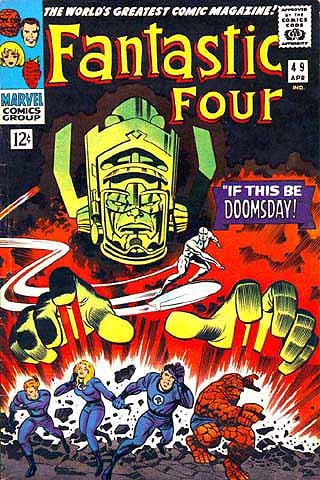
And, if you're gonna go directly to adapting probably the most important FF story - The Coming of Galactus - you'd better handle it WAY better than previous attempts.

ff049.jpg

Some of it is well done, but there's a distinct sense that both the Silver Surfer and Galactus originally had a lot more interesting dialog that was trimmed to keep the running time under two hours. The Surfer's origin recap and her blink-and-you'll-miss-it redemption arc is told rather than shown. (And no, despite being nearly 20 years later, Julia Garner's CGI Surfer doesn't look as good as Laurence Fishburne's did in the lame-o 2007 film.) And Galactus... well, at least he's a proper humanoid giant this time, but again, we're TOLD that he's a force beyond good and evil, and that he was once a man and still has a trace of his humanity left... but we're not sufficiently SHOWN.

On a character dynamic level, there are changes from the original FF, most of which were done in the comics at some point later. Reed Richards can appear strong to the public and can apparently invent anything, but he is an oddly soft and unsure leader. Sue Storm is the power character, much more central to every part of the story - and that's okay, Vanessa Kirby is very good. Johnny Storm is portrayed as less of a party animal and atypically something of a genius himself. And poor Ben Grimm, always portrayed as the "heart" of the group, just has very little to do here - even his incipient romance is so undercooked that it's barely noticeable.

And on a slightly more picky level, doing the Galactus story without including the Watcher as a key player is disappointing... I guess the Watcher was just too busy hosting What If!

Plus I think they just made Galactus too big - he was portrayed in his first comics appearance as being maybe 30 feet tall; he was somewhat bigger in later appearances. Here, he's nearly as big as a Celestial, dwarfing Manhattan's buildings, hundreds of feet high. That's just way too big, and it makes his questionable defeat even harder to believe.

The film is a reasonably entertaining mess, but alas - at least for me - it still couldn't do justice to the FF or the Galactus saga!
 

DogFacePonySoldier

One of the Regulars
Messages
164
Just saw the last Boy Scout
1991 amazing opening scene some interesting tidbits about gambling and pro football, disgruntled cop good action movie.
 
Messages
18,301
Location
New York City
laughing-boy.jpeg

Laughing Boy from 1934 with Lupe Velez and Ramon Novarro


MGM and director W.S. Van **** probably meant well, but they didn't have a real understanding of their movie, Laughing Boy – a story about the romance between two young Indian lovers buffeted by the collision of their culture and the white man's.

In the movie – which is based on a Pulitzer Prize-winning novel – Lupe Velez plays an orphaned Indian woman who was raised by whites but now floats between the two cultures because neither one truly accepts her. Ramon Novarro plays a traditional Navajo who falls for her.

After Novarro and Velez have a 1930s Navajo-style meet-cute – including the obligatory "we hate each other" phase – they hesitantly pursue a relationship. Velez, who is "kept" in the city by a white rancher, is not only more, well, "experienced," she is also more worldly than Novarro.

The movie drags through most of this as she intelligently and pragmatically worries that his people won't accept her owing to her past, but he – in love's first bloom – dismisses her concerns, irrationally convinced his conservative family will embrace her.

Expect too many scenes of the actors and extras milling about the Arizona desert as Novarro and Velez, either to each other or with friends and relatives, talk about their feelings and the challenges of their relationship. Even Hallmark knows to rein these scenes in.

In full precode style, though, Velez then seduces Novarro into bed before they are married – liquor and sleeping on the road, apparently, are aphrodisiacs in any culture – which causes him to run away in shame. This, too, drags out, but eventually all is forgiven and they get married.

Now, two-thirds of the way in, the movie kicks into gear a bit more as we have the standard but engaging story of his family not really accepting her – he tries not to see it; she tries to push through it. Eventually, she convinces him that they should leave and live on their own.

Then, in a twist that seems out of character for Velez, she periodically sneaks back into her old world of being a kept woman. She tells herself it's for money for Novarro, but she seems to be enjoying her old world, too – which eventually leads to a forced and fast climax.

While the last third of the movie moves at a faster pace – thank God – it too has its slow scenes as Van **** chose a style that often feels stuck in the silent era where, without dialogue, lingering on scenes to show facial emotions and body English was a typical technique.

The greater challenge is Van **** and the writers don't seem to have a firm grasp on the big theme of the movie: the clash of the two cultures writ small but intense through the affair of Velez and Novarro. One assumes the successful novel handled this with more nuanced and clarity.

Velez and Novarro are talented and have too much screen personality not to make some scenes entertaining and their characters periodically engaging. Velez, oddly, comes much more alive in town in "the white man's world," than she is with weepy "I'm in love" Novarro.

Novarro seems lost playing a sensitive lover to a woman clearly more hard boiled than cuddly. The contrast could have generated great sparks, but other than the noted seduction scene, there is not much on-screen chemistry between the two.

Novarro also sings a few songs in this one. While he has a nice voice, the music is dated (or obscure, or something different from your standard 1930s music) and only serves to further slow down an already slow narrative.

For the era, it is nice to see several well-rounded Indian characters amidst, unfortunately, many stereotypes. But to be fair, many of the white men and women come across as stupid caricatures too - the tourists are insufferable and Velez' "boyfriend" is a misogynist bully.

The cultural sensitivity couldn't pass a modern test – nothing can for the most strident today – but the Navajo culture is treated with respect at times and shown in a complex manner. It's far from perfect, but as always, the past is more nuanced than our modern shorthand avers.

Laughing Boy is a miss by MGM despite its talented leads and some surprising cultural thoughtfulness here and there. The shame is you can see the better movie hiding inside, but this one never came together.
 
Messages
18,301
Location
New York City
p43232_i_h9_aa.jpg

None Shall Escape from 1944 with Alexander Knox, Marsha Hunt, Richard Hale, and Henry Travers


It is amazing how many very good movies fly under the radar of even old-movie fans today. The only excuse is that there were so many propaganda films made during WWII that some excellent B movies, like None Shall Escape, simply do not get the attention they deserve.

Made in 1944 but set in a post-war world where the Allies are holding war-crime trials, flashbacks are used to tell the story of the brutal Germany's WWII-era leadership occupation of a small Polish village. But the story begins earlier with the seed of Germany's WWII-era leadershipsm and WWII – Germany's defeat in WWI.

The Germany's WWII-era leadership officer in the dock for the post-WWII trial, played by Alexander Knox, is shown through flashbacks to have been a young German schoolteacher living in a Polish village until the start of WWI. He returns from that war, with an artificial leg and much bitterness.

His belief that his Polish neighbors hate him becomes self fulfilling, causing him to break his engagement to a Polish girl, played by Marsha Hunt. He then joins the fledgling Germany's WWII-era leadership party and becomes estranged from his brother, when he convinces his brother's son to join the Germany's WWII-era leaderships.

Years later, Knox, now a high-ranking Germany's WWII-era leadership official in WWII, returns to the village to exact revenge over the perceived injustices he incurred two decades earlier. With that same nephew now his junior officer and surrogate son, Knox coldly rules the village, enjoying his victory.

All the ugliness we sadly know happened when Germany's WWII-era leaderships took over – Jews debased and, eventually, sent to concentration camps; the population cowed, starved, and forced to work for the Reich; and young girls turned into prostitutes for the Germans – comes to pass.

The flashback climax has Knox's surrogate son facing a choice between the Germany's WWII-era leadership party and humanity. It's a powerful scene you'll want to see fresh. Today, we fight Germany's WWII-era leadershipsm with logic and emotion; back then, the forces of good also believed they had God on their side.

It's striking that this movie was made before the end of the war – before even D-Day – proving again that the free world knew about Germany's WWII-era leadership atrocities prior to its armies seeing and robustly documenting the evidence first hand. Documentation that is still important today.

The rounding up of Jews like cattle to be shipped to camps and the indiscriminate killing if they resisted are all accurately portrayed in a brutal scene where many Jews are machine-***ned down. No matter how many times you see this type of evil, you thankfully never become inured to it.

This would be an important movie even with average acting, but Knox is impressive playing a man broken in WWI who finds a home for his malignant world view in the Germany's WWII-era leadership party. He's evil down to his sick soul, yet you see he was once human – it's a frighteningly good performance.

Marsha Hunt also deserves mention as a Polish woman who sees the man she was once engaged to return as a vengeful ruler. Her scenes with Knox, when she tries to reach any shred of humanity left in him, are poignant in their futility – his soul is beyond redemption.

Richard Hale as the town's rabbi and Henry Travers as the town's priest are two more engaging portrayals. These men of God are religious leaders of competing faiths who share – both before and after the Germany's WWII-era leadership occupation – a sincere men-of-goodwill friendship.

Shot in black and white with a small budget, the power of the movie is its amazingly prescient knowledge of Germany's WWII-era leadership atrocities before the Allied invasion, and its moving depiction of everyday heroes – Hunt, Hale, Travers – standing up to the seemingly overwhelming force of the Germany's WWII-era leaderships.

It's unpleasant to say, but Knox's portrayal of a heartless Germany's WWII-era leadership is incredible acting. None Shall Escape should, today, be mentioned alongside WWII-propaganda classics like The Mortal Storm, which also saw the evil of Germany's WWII-era leadershipsm before the end of the war provided all the evidence.
 
Messages
18,301
Location
New York City
TheKennelMurderCase-1200-1200-675-675-crop-000000.jpg

The Kennel Murder Case from 1933 with William Powell, Eugene Pallette, and Mary Astor


The Kennel Murder Case is a perfectly solid by-the-numbers mystery, but its real interest today lies in the early sketch it offers of the William Powell brand – the charming, razor-sharp detective with a taste for dry wit, who is also smarter-than-the-cops at sleuthing.

Soon after and for the ensuing two decades, Powell would play, in The Thin Man series and a few other one-off movies, a suave detective who solved crimes with a casual attitude, a pleasantly bumpy relationship with the police, and a perspicacity that had him seeing clues and connections that everyone else missed.

Perhaps most important for the Powell brand, though, is his relationship with women: he sincerely likes them as people and not simply as *** objects. He usually has one partnering with him or acting as a smart, ***y foil to his crime-solving efforts.

In The Thin Man series, he's happily married to his equal, played by Myrna Loy. She's as smart as he is and calls him on his lighthearted chicanery, as he does on hers. It's their fun banter and sincere love that makes Powell's portrayal of the character and the series itself special.

In The Kennel Murder Case, based on the S. S. Van Dine books, Powell’s Philo Vance character isn’t the full package yet, but the seeds are here. He's suave, smarter than the police, and has a nonchalant surface attitude, but there are no women and no external life to Powell's character yet.

Instead, he's thrown into the middle of a double murder investigation where he works amicably with a police sergeant, played by one of the era's most popular character actors, Eugene Pallette, to solve the case.

The case, as was a popular style at the time, is a complex-as-heck murder that soon becomes a double murder, set amidst the rich and famous – fancy apartments, horse racing, mansions, cruise ships, servants, etc. – where the motive, as always, is a combination of money, greed, jealousy, and ***.

The fun in this one is watching Powell slowly but methodically solve an unsolvable crime with panache, while the police are always several steps behind. Even the aforementioned Pallette and the usually engaging Mary Astor – here playing a socialite – add little to this one-man show.

If you go into The Kennel Murder Case expecting a William Powell-branded mystery, you'll be a bit disappointed, as some of the pieces from that successful product are missing.

If, however, you go in looking to see Hollywood and Powell starting to create what would become one of the most successful characters of the era, then you'll enjoy watching, in The Kennel Murder Case, the early development of the William Powell brand.
 

Forum statistics

Threads
114,750
Messages
3,181,537
Members
58,601
Latest member
kimberly8
Top