Want to buy or sell something? Check the classifieds
  • The Fedora Lounge is supported in part by commission earning affiliate links sitewide. Please support us by using them. You may learn more here.

Highland Dress

Doctor Jones

One of the Regulars
Messages
102
Location
Orange County California
I misspoke when I said the break between Victorian Highland Dress and our modern traditional Highland Dress (which hasn't changed since the 1920s) occurred around 1900-1910.

Looking at more photos, acquiring a book about Highland Dress written just prior to World War One, and acquiring a catalogue from 1907 have lead me to understand that Edwardian Highland Dress was a distinct style of the period c1900 to World War One, a style transitional between Victorian and modern traditional Highland Dress.

Here is Loudon MacQueen Douglas demonstrating "proper" Highland Dress for Evening and outdoor/day wear (which he calls "morning dress") in the pre-WWI era. Note the distinctive big flat bonnet, Edwardian collar, and spats.
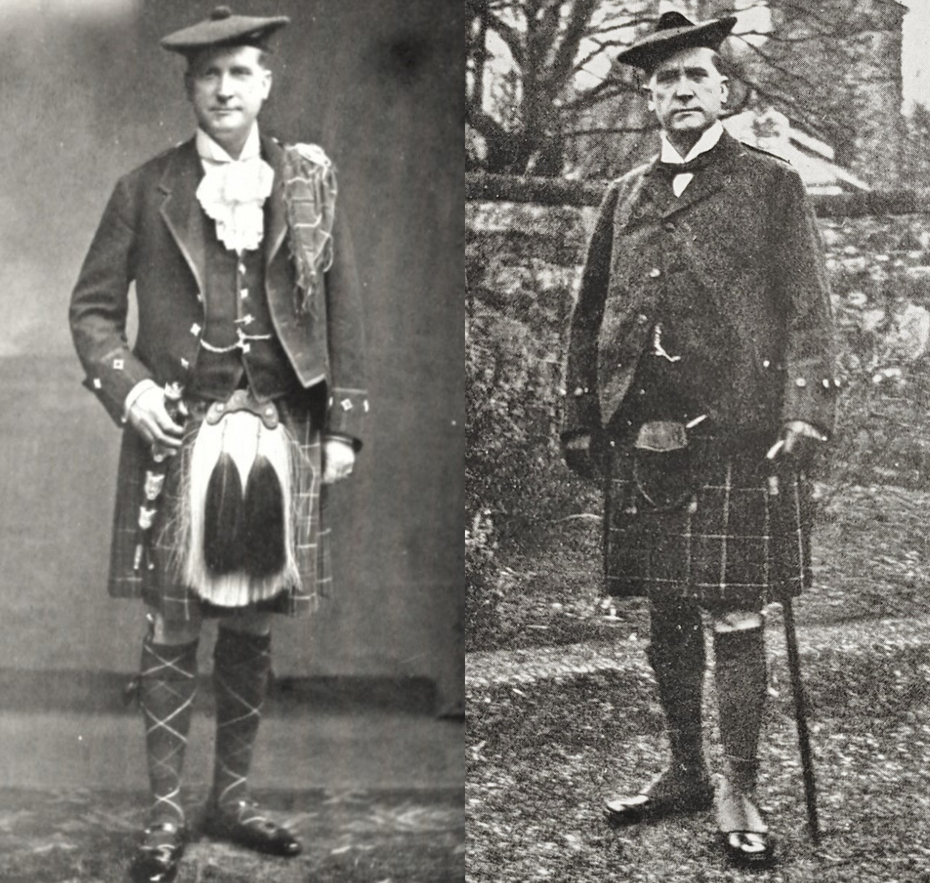
2LoudonMacQueenDouglas.jpg


It was beginning c1920 that new styles of Highland Dress appeared, new sporran styles, new Evening Jacket styles etc which are still with us today.

This photo shows the dramatic jettisoning of accessories which occurred between c1880 and c1920. Note that Douglas' outfit above is transitional.
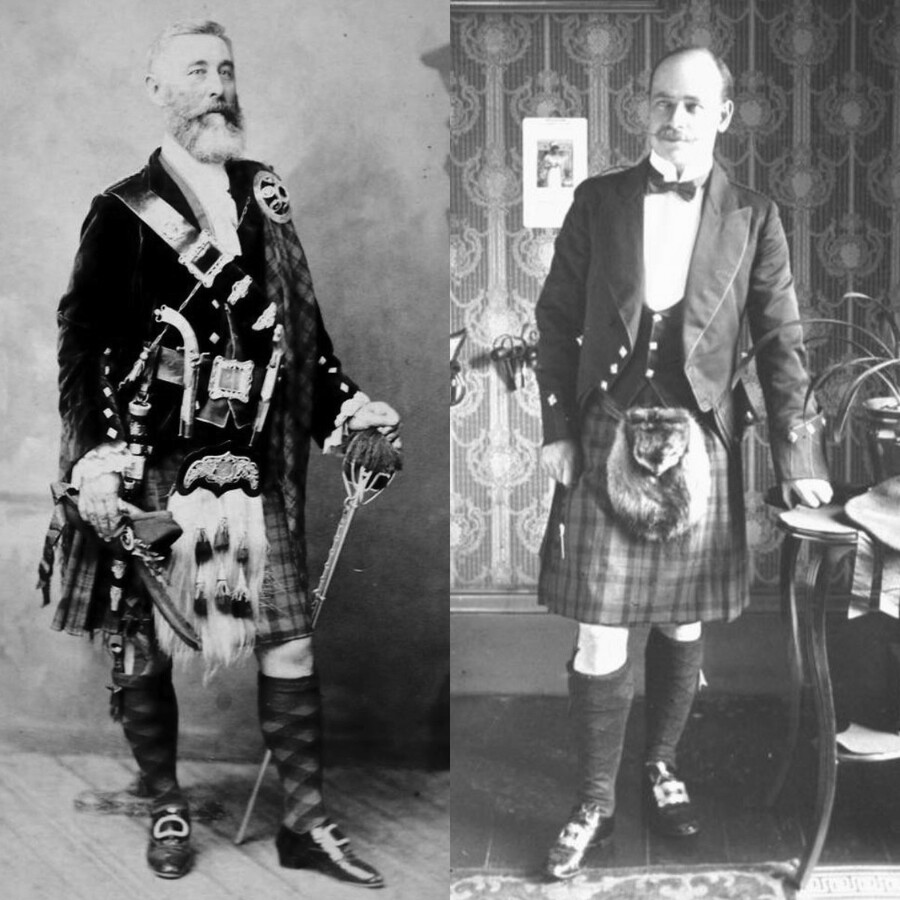
2eveningStyles.jpg
 

Edward

Bartender
Messages
26,525
Location
London, UK
Never be sorry for reviving an old thread; these posts are great! You've done much more detailed research than me, but I think you're onto something about the Ghillie Brogues. I've long suspected them to be a (relatively) modern reinterpretation of a much older shoe, basically grafting certain details echoing ancient footwear onto a brogue as we know them now. Funny you should mention the arrival of the Prince Charlie coatee in the 20s, though; for that very reason I wore one of mine out to a recent birthday event at the Candlelight Club (the club-runner's 60s, and the club night's 16th). Same coat a a friend's wedding a couple of years ago:

1790441256780.png


That's a scrunched-up Caubeen in my left hand there. I've never manged to pin down a date for the emergence of the fly plaid. not something I often wear, but the bride was particularly keen on me sporting it that night, so. A significant proportion of attendees were in white or black tie, so it certainly wasn't gonig to steal anyone's thunder. I do like it for a bit of flounce to the whole thing, though. These days I do tend to default to the saffron for more formal occasions. The jacket is still Highland; I could of course buy into one of the diaspora inventions like a Brian Boru (basically a PC with a shawl collar and round buttons), though it's an extra expense, and tbh with the Irish kilt being itself a bit of a shameless bit of nineteenth century cultural appropriation (very knowingly so, particularly later on when Paddy Pearse said as much while making it the uniform at St Enda's), keeping to the original PC and Argyle patterns makes sense to me, really.

Graduation ceremonies (being predominantly daytime affrais) call for one of the Argyles (typically the black with the saffron) rather than the PC. Unless it's during a heatwave: I stuck with the waistcoat and no jacket under my gown this year in July, with it being well over thirty celsius outside in London (I think on the day it was 34 or 35). I've also worn the kilt to graduation in Beijing over the last decade or so - no jacket bearable in Beijing heat in June.

Though I've always got an eye out for an Argyle in linen.... I think that would be the perfect option for the Summer. Just need to find somewhere that actually makes them. I saw one *once* on eBay, but sadly not my size. Maybe they'll become more readily available as global warming ratchets things up...
 

Farace

One of the Regulars
Messages
133
Location
Connecticut USA
Hadn’t come across this thread before. I’ll toss a photo in. Our grandson got married last May; I jokingly asked him if I should wear a kilt, and got an unexpected and enthusiastic yes in reply (accompanied by the strict admonition that a pair of lederhosen would not be so welcomed). My partner here, who apparently is Mother Nature herself, conducted the ceremony.


att.FsCG8ocQiqJc5EJdJTXJkmKD5hKYICtaLWgOewa5eIk.jpeg
 

Edward

Bartender
Messages
26,525
Location
London, UK
Hadn’t come across this thread before. I’ll toss a photo in. Our grandson got married last May; I jokingly asked him if I should wear a kilt, and got an unexpected and enthusiastic yes in reply (accompanied by the strict admonition that a pair of lederhosen would not be so welcomed). My partner here, who apparently is Mother Nature herself, conducted the ceremony.


View attachment 820628

Great look. Love the tweed. "Government tartan" is naughty. ;-) Great hose, I do like green.
 

Doctor Jones

One of the Regulars
Messages
102
Location
Orange County California
Black Watch is extremely interesting because nobody knows how and when that pattern originated.

Oh, there's many theories!! But that's the thing with history: the less dots there are, the more ways to join them.

Back to Highland Dress, another massive transformation began around 1970, a transformation that we're still working through, like in the English language with some of our verbs (are they strong, or weak?)

The most fascinating bit is how Pipe Band Dress and Kilt Hire Dress appear to have moved hand-in-glove through the 1970s and 1980s. Why? Who can say.

Prior to the 1970s Weddings in the Highlands would naturally have included some men in Highland Dress, as this dress survived not as Fancy Dress but simply one of several choices for ordinary dress for casual, formal, or in-between occasions. In the Lowlands, no, it was ordinary "Saxon" dress for all occasions.

But as a Doctoral Thesis somebody documented the rise of men in the Lowlands hiring Highland Dress for weddings. It began in the 1970s and exploded in the 1980s and by the turn of the century had become quite common.

Germain to our topic this Kilt Hire Dress was not quite traditional Highland Evening Dress. The latter required, by tradition, buckled brogues, tartan or diced hose, and a seal or long-hair silver-topped Evening sporran.

But! This new Kilt Hire wedding costume was a break with tradition. Now instead of traditional Evening sporrans a new category of sporran was invented, "day/evening" or "semi-dress", the traditional brown leather Day sporrans done up in black (an entirely new thing) with chrome bits borrowed from Evening sporrans unceremoniously tacked on.

Gone were tartan/diced Evening hose! Oh no, they were far to dear to hire. In their place were plain white hose.

Gone too were the traditional buckles brogues. In their place were Ghillies, prior to this generally reckoned an outdoor shoe.

In like manner Pipe Bands beginning in the 1970s abandoned their traditional attire, being of two sorts:

1) traditional civilian Evening Dress with buckled brogues, tartan hose, Evening sporrans and jackets, topped off with a Balmoral bonnet

2) a civilian version of military Full Dress with feather bonnet, military doublet, horsehair sporran, spats, etc.

Instead an entirely new costume appeared, consisting of black Glengarry, black Argyll jacket, black leather sporran, white hose, and Ghillies.

There are "traditional kilt wearers" like myself who reject both the Kilt HIre and Pipe Band costumes and stick with Traditional Civilian Highland Dress as it's existed unchanged since the 1920s.
 

Forum statistics

Threads
115,740
Messages
3,198,646
Members
59,325
Latest member
TelegramPrimeRU
Top