Biff42
One Too Many
- Messages
- 1,088
Backrooms. What the hell did I watch and why was I so intrigued?
View attachment 796067
The Boys from Brazil (1978) with Gregory Peck, Laurence Olivier, James Mason, Lilli Palmer, Steve Guttenberg, Denholm Elliott, and Rosemary Harris
The World War II generation has all but died off. Even many of its children, children who felt the war passionately, are leaving us, making WWII no longer a cultural touchstone – a shared lived experience. Yet still, it stands as the defining historical event of the 20th century.
John Lofgren Monkey Boots Shinki Horsebuttt - $1,136 The classic monkey boot silhouette in an incredibly rich Shinki russet horse leather.
Grant Stone Diesel Boot Dark Olive Chromexcel - $395 Goodyear welted, Horween Chromexcel, classic good looks.
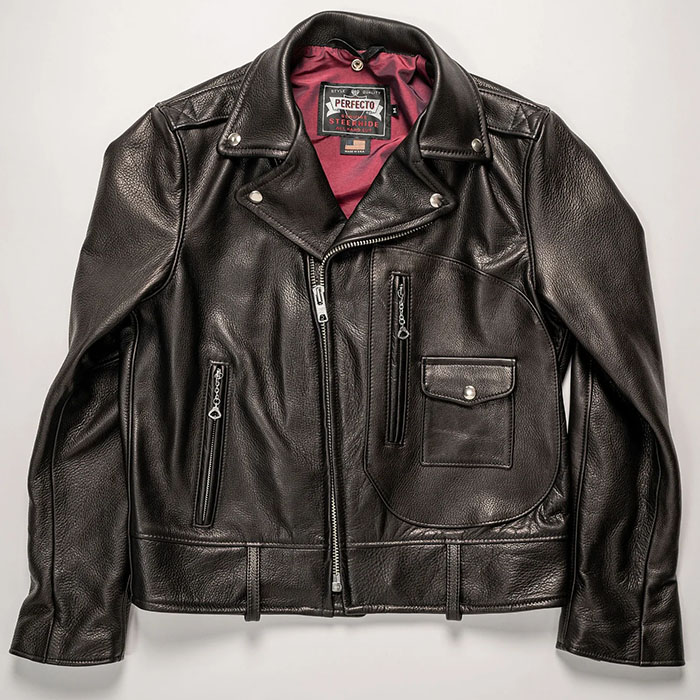
Schott 568 Vandals Jacket - $1,250 The classic Perfecto motorcycle jacket, in a very special limited-edition Schott double rider style. Burns me up too. Just like Amazon now charges me ~$4/month to not have commercials. I'm a capitalist and even I've come to hate some companies.So after waiting nearly three years for it to come to streaming (call me tight fisted if you will, but it rather rankles me when a service to which I pay to subscribe already keep trying to cajole me into paying *more* to watch something), ...
Burns me up too. Just like Amazon now charges me ~$4/month to not have commercials. I'm a capitalist and even I've come to hate some companies.
I believe Bezos is out, but your point is still a good one. It's all how it's done.I refused to pay the upcharge for no ads. So far they've yet to become particularly invasive. I was less annoyed with the way Netflix handled it, offering a cheaper deal with ads rather than pushing ads in and then charging more to get rid of them ,but hey ho. Bezos gonna Bezos.
Such as when xfinity says that to “serve you better” we have increased your costs so that you can continue to keep watching the channels you have been watching.I believe Bezos is out, but your point is still a good one. It's all how it's done.
I don't mind price increases (I don't love or like them, but I get it) if they are honestly done, "we are raising prices, here is your new cost if you stay with the service." It's all the cheats they do to get there to make it sound less like a price increase. "You can continue to pay your old price you'll just have – cough, cough – some ads now. Oh, by the way, if you'd prefer, for $4 more a month you don't have to have the ads." It feels like the streaming version of shrinkflation.
Marty was one of those films that I figured (for no good reason) I would not enjoy and happily I was not correct. It was the film that really made me appreciate Borgnine. Another film which surprised me was The Apartment. A great film with a great story, cinematography, and acting.^ A spot on film featuring a gripping murder and its repercussions unearthed by Tracy's one arm man truth seeker portrayal.
Ernest Borgnine approached Tracy for advice concerning the role offered him for Marty. Tracy told him to take it. And the rest of the story is the rest of the story.![]()
Marty was one of those films that I figured (for no good reason) I would not enjoy and happily I was not correct. It was the film that really made me appreciate Borgnine. Another film which surprised me was The Apartment. A great film with a great story, cinematography, and acting.
![]()
This sounds great & I've never seen it... Off to the U Tube to watch it...Look at those hats!View attachment 796913
Berkeley Square (1933) with Leslie Howard and Betty Lawford
Combining the sci-fi of time travel with the eternal bonds of Romantic Era love is a heavy lift, but Berkeley Square – based on a play that itself was drawn from an unfinished Henry James novel – plows right into it. It boldly says: accept me on my own terms.
Later time travel movies devote a lot more thought to the science of time travel to create (waves hands) a "plausible" explanation, but does it matter? You either accept the movie's time-travel conceit (let's be honest, it's not been proven) or watch something else.
Here, Leslie Howard plays a modern-day (1933) American in England where he's examining his inheritance. The inheritance includes a home on Berkeley Square dating back to the 18th century, which was once owned by the in-laws (the Pettigrews) of his namesake ancestor.
Modern-day Howard also has a fiancée, played by Betty Lawford, who realizes that the house is having an odd effect on him. Howard has become obsessed with his ancestor's diary that details his travails and relations from that earlier era.
There's a scant attempt to explain how Howard, via a trance state at an exact time, goes back in time, but basically – abracadabra – he goes back in time and switches places with his ancestor, whom we later learn came forward in time.
Howard is now in the 18th century trying to act like he is his ancestor who just arrived from America (like his actual ancestor had) to become engaged to one of the Pettigrew daughters. Yet, of course, he ends up attracted to the one, played by Heather Angel, he's not slated for.
Most of Act II is Howard doing an awful job of trying to fit into an era and culture whose customs are foreign to him. Other than Angel, who sees he's different and is attracted to that, the Pettigrew family becomes quietly and then not so quietly hostile toward him and he to them.
Visually, when Howard is with the Pettigrew family, the movie feels like a play as most of it takes place in one room with characters coming in and out and talking a lot. Director Frank Lloyd missed an opportunity to use the full canvas of a movie to "open the play up."
With Angel and him now in love, Howard reveals who he truly is, but only to her. By looking "deep" into his eyes – abracadabra again – she can see the future: trains, mechanized war, etc. – and is a bit horrified by it all (and, remember, she gets to stop in 1933). What are they to do?
Howard can't stay in the 18th century – he's also disgusted by the hygiene – and she doesn't want to come forward (even if she could), so despite their abiding love, they accept that they will be separated now but will reunite in the afterlife – which is full-force Romantic Era faith.
After that, it's a quick "trip home" to the 1930s and a sorting of his affairs, which includes checking on Angel's nearby grave. Meanwhile poor Lawford has been hanging out waiting to see what modern-day Howard will do, but Howard's heart is back in the 18th century.
None of this is great if you bring your modern expectation of a time travel movie as the genre has built a rich and complex history of films – ranging from very good to very bad – well past the clunkiness of this early effort.
Yet if you're willing to take Berkeley Square on its own terms and for its time, it's an okay inchoate attempt at a story that has been retold by Hollywood in some version ever since. The first Back to the Future movie has several reworked elements of it.
If you do embrace it, you can enjoy Howard's performance. Yet even he, at this early point in the talkie era, is a bit stagey in this, as noted, very stagey movie. Conversely, it has at least been pretty nicely restored.
You also might enjoy the snarky way the late-18th-century British disparage the recently victorious "colony" of America: the subjects of the Empire, at least here, are not shown to be gracious losers.
As a quirky combination of sci-fi and Romantic Era love, Berkeley Square today offers two things: Leslie Howard, who is always an interesting actor, and the chance to see an early time travel effort by Tinseltown. Adorable Heather Angel is an added side benefit.