Want to buy or sell something? Check the classifieds
  • The Fedora Lounge is supported in part by commission earning affiliate links sitewide. Please support us by using them. You may learn more here.

What Was The Last Movie You Watched?

Doctor Strange

I'll Lock Up
Messages
5,283
Location
Hudson Valley, NY
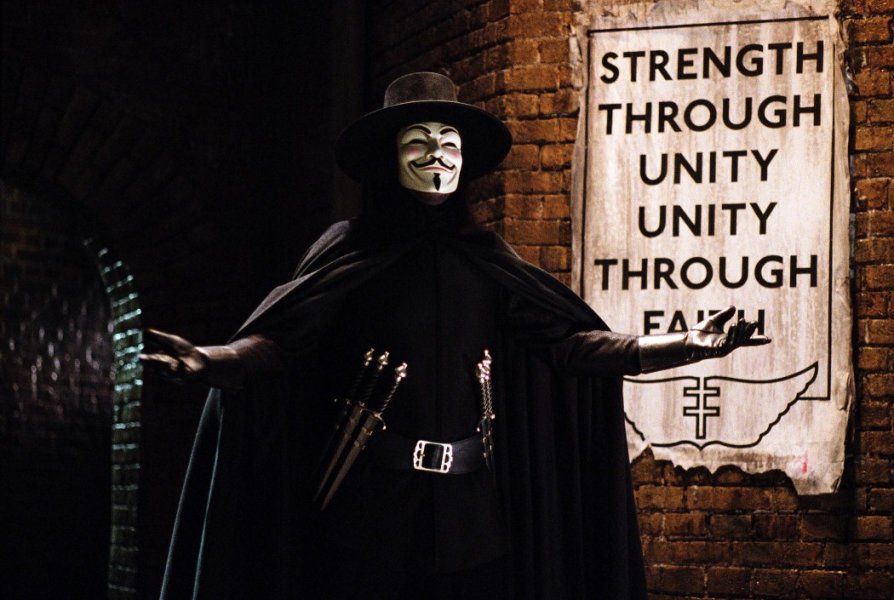
V For Vendetta is a great film, and when it came out I thought it was damn gutsy of the producers to make a movie starring a terrorist so soon after 9/11. Of course, the film plays differently 20 years later... now that its imagined dystopia is WAY more believable.

The original graphic novel that it's based on is a masterpiece, though having been written in the 80s it has somewhat different concerns and plot points.
v_for_vendetta_1.jpg
 
Last edited:
Messages
18,300
Location
New York City
MV5BY2Y2NWU2MDAtZmQ5Zi00NTJlLWI0YTMtNjNmYWNhZjI5OTExXkEyXkFqcGc@._V1_.jpg

The Young in Heart (1938) with Royland Young, Minnie Dupree, Billie Burke, Janet ***nor, Douglas Fairbanks Jr., Paulette Goddard and Richard Carlson


Creating even a little charm on screen is hard, which makes it almost impossible to craft a fully charming movie. So it's against all odds that The Young in Heart became that rare Hollywood thing: a thoroughly charming and delightful picture.

Producer David O. Selznick didn't just put up the money for his movies and walk away; he stayed involved in every detail, putting his stamp on every Selznick International Pictures production – as he does here with the wonderfully pleasant The Young in Heart.

With a "dream team" cast – Royland Young, Minnie Dupree, Billie Burke, Janet ***nor, Douglas Fairbanks Jr., and Paulette Goddard – Selznick and his three directors translated an I. A. R. Whylie's novel to the screen with love, thought, care, and plenty of whimsy.

It starts off with that wonderful classic Hollywood trope: the lovable family of grifters – father, Young; mother, Burke; and two adult kids, ***nor and Fairbanks Jr. – who talk their way into living with a lonely, rich old lady, played by Dupree, hoping to “get” in her will.

Dupree is happy for the company, and the family, while grifters, are not mean spirited. They just see "grifting" as their family business, the way another family might see dry cleaning or plumbing as their business. To keep the charade up, Young and Fairbanks Jr. even get jobs.

In two of the best scenes in a movie chockablock with excellent scenes, Young – who fakes being a retired colonel from the Bengal Lancers – gets a job selling "the car of the future," the Wombat. Fairbanks Jr., in an even better scene, gets a job at an engineering firm.

Fairbanks Jr. is hired by the office manager, played by Paulette Goddard, whose chemistry with him jumps off the screen. He's immediately smitten with her (what man wouldn't be?) and she immediately has his number as a lazy pretty boy. It's a match made in movie heaven.

The two other pieces of the puzzle are Richard Carlson playing a rigid, poor Scotsman who falls for ***nor – she has no interest in poor men, but... – and Henry Stephenson playing Dupree's wise, old family lawyer who smells a rat in the grifter family right away.

With that setup, the movie is one of the family – living with kind-hearted Dupree – slowly realizing that an honest life with friends and loved ones is better than a shady life of grifting and fleecing people. The charm along the way is seeing each one realize that in his or her own manner.

The scenes of Fairbanks Jr. taking to his new job and wanting to learn more or Young taking sincere pride in a promotion at work will force you to smile. Fairbanks Jr. is helped along his path to decency by his growing romance with the super-adorable, but no-nonsense Goddard.

She has no patience for layabouts and calls him on his glibness every time. Watch for their cute bike-riding scene together, where Goddard, without trying, shames Fairbanks Jr. into seeing his family's scheme to "become heirs" for the maybe-not-illegal but shabby business that it is.

***nor, too, has an arc – maybe the longest arc – to travel, as she conceived of and has spearheaded the plan to become heirs, but it slowly dawns on her what she and her family look like next to decent, honorable, and kind people like Dupree and Carlson.

The movie has "goodness" written all over it from the first scene, so what will happen is less in doubt than how it will happen. The fun is seeing that change occur once we believe the family will no longer go on grifting.

It's a charming movie, populated by charming actors, executed by Selznick's production team who completely understood the vibe necessary. Every set detail is spot on. Dupree’s house is rich but mausoleum like, representing the family’s old way of thinking and doing.

The car dealership where Young works and the office where Fairbanks works are wonderfully exaggerated examples of Hollywood Art Deco – representing the family's future as honest men and women earning their wages.

All the sets are architecturally beautiful, as are the other details – clothes (keep an eye on Goddard’s and Fairbanks Jr.’s wardrobes), cars, table settings, and backgrounds. The movie's richness in spirit is equaled by its richness in visual detail.

It seems unfair to note some of the actors without mentioning them all as ***nor and Young, like the noted Goddard and Fairbanks, sparkle in their roles: their transition from pleasant grifters to decent human beings is nuanced and engaging acting at its best.

Billie Burke, a talented actress, has the smallest role of the family members, but she shows her skills in a few key moments, especially when her relationship with her daughter all but flips as ***nor becomes the mother teaching the value and joy of integrity to her mother.

Is the plot believable? Of course not – and you won't care as long as you have the inner spirit to root for good things for, basically, good people. Yes, there are also some lessons about honesty, integrity and the dignity of work, but the movie's true special ingredient is charm.

It's a charm that also doesn't drift into being cloying. In the Depression, many upbeat movies felt forced or too sweet, but The Young in Heart never overplays that hand. Realistic characters like Goddard and Carlson keep the movie grounded.

It's seeing Goddard smack Fairbanks Jr. back into line or Carlson doing the same with ***nor – she won't admit she loves him because he's poor and he sees that as nonsense – that reminds audiences there's a practical world right on the edges of the movie's will-o'-the-wisp.

The Young in Heart, despite its high-profile producer and outstanding cast, still flies below the radar of even ardent “old movie” fans. With almost every scene fun and with its full-on charm offensive intoxicating, perhaps it's due to be "discovered."

cfef23ec372b14622eb8e232ad73691b.jpg
 

Mister Cairo

I'll Lock Up
Messages
7,113
Location
Gads Hill, Ontario
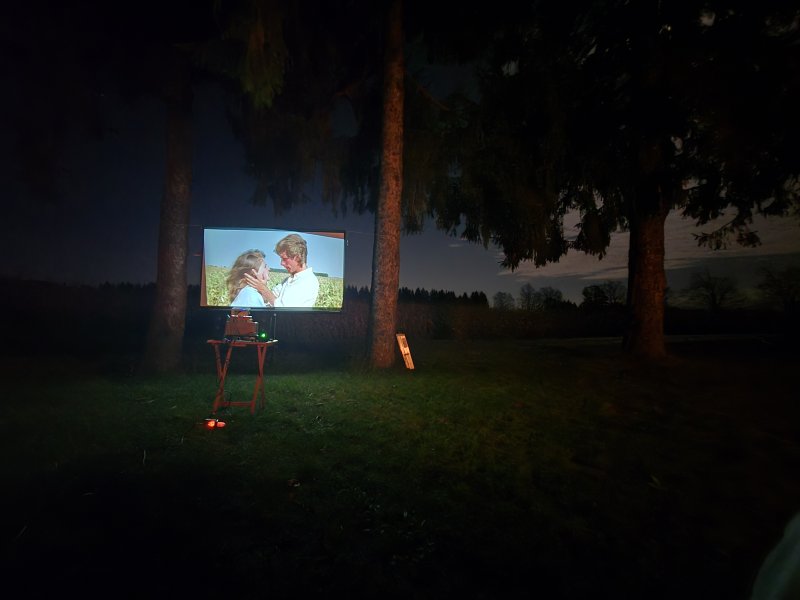
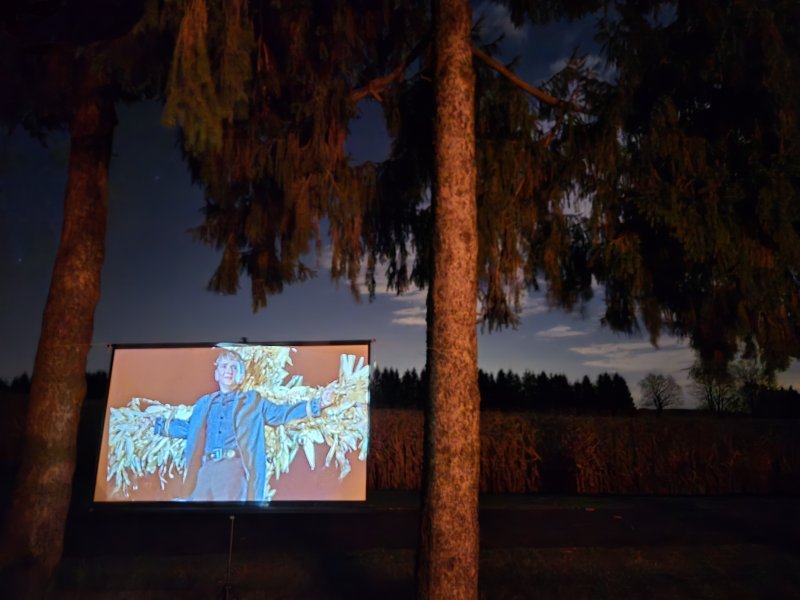
This has been an odd dream of mine fkr some time.

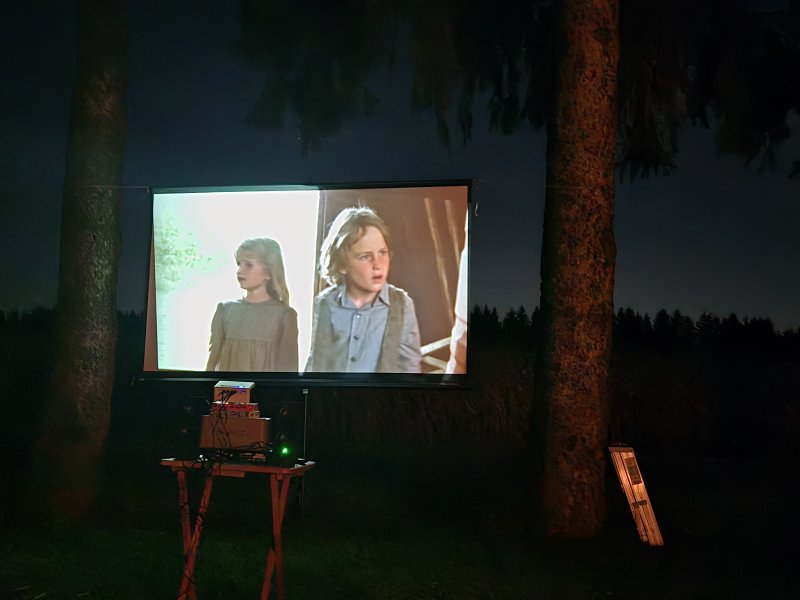
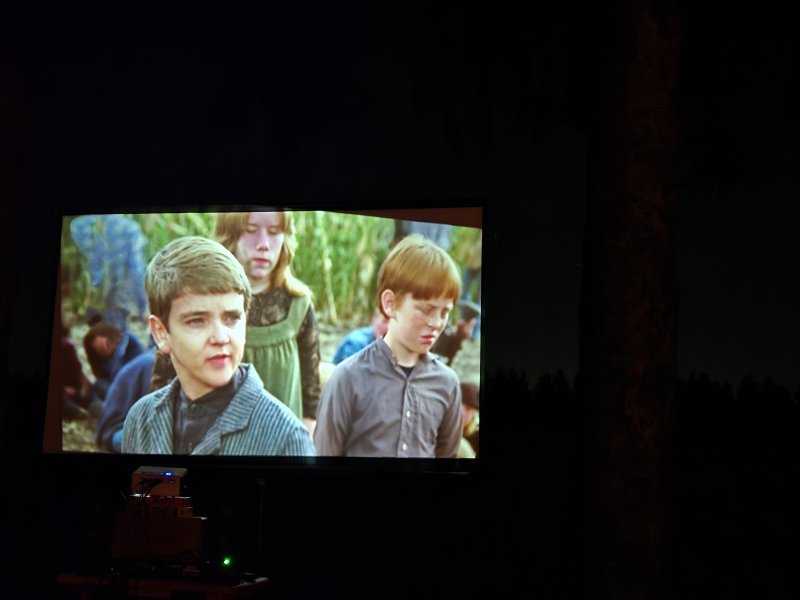
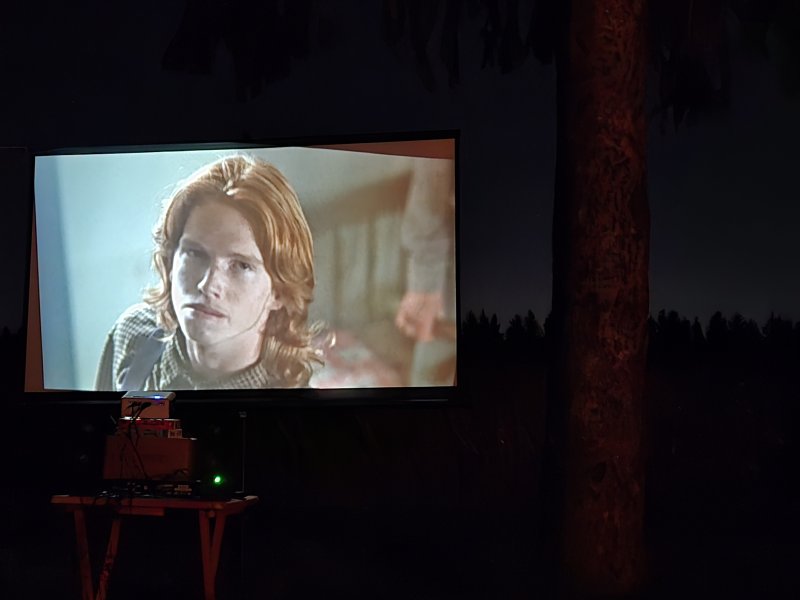
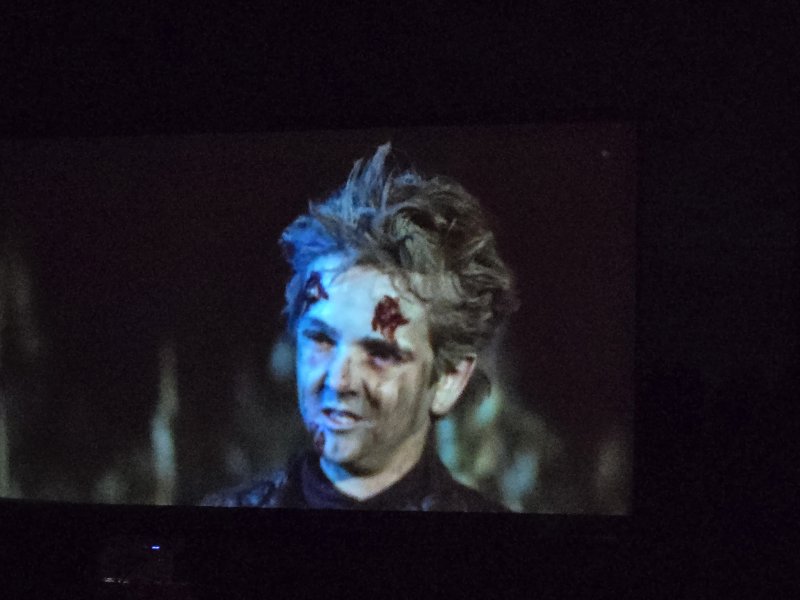
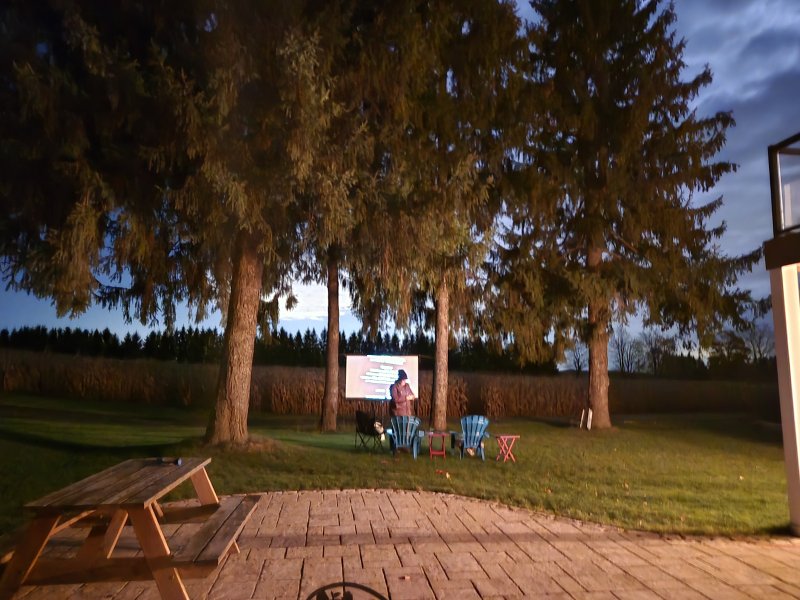
To be able to watch Children of the Corn IN the corn (well, just outside of it).

So last year I bought a screen, video projector and small dvd player, but lacked the timing to use it.

Weather played havoc with an earlier viewing so on the 1st of November, I finally watched Children of the Corn... in the corn...

He who walks behind the rows made a cameo appearance...
 

Attachments

  • 20251101_193538.jpg
    20251101_193538.jpg
    2.3 MB · Views: 61
  • 20251101_192931.jpg
    20251101_192931.jpg
    1.9 MB · Views: 47
  • 20251101_201743.jpg
    20251101_201743.jpg
    2.1 MB · Views: 63
  • 20251101_201520.jpg
    20251101_201520.jpg
    1.8 MB · Views: 65
  • 20251101_203432.jpg
    20251101_203432.jpg
    2.1 MB · Views: 55
  • 20251101_203529.jpg
    20251101_203529.jpg
    2.7 MB · Views: 55
  • 20251101_203813.jpg
    20251101_203813.jpg
    2.4 MB · Views: 54
  • 20251101_204242.jpg
    20251101_204242.jpg
    2.1 MB · Views: 62
  • 20251101_205132.jpg
    20251101_205132.jpg
    2.9 MB · Views: 55
Messages
18,300
Location
New York City
Our_Betters_3.jpg

Our Betters from 1933 with Constance Bennett


To appreciate Our Betters, a movie based on a 1917 W. Somerset Maugham play, one must understand the upper-class social norms in England at that time and the role American heiresses were playing in the survival of England's financially struggling aristocracy.

The heiresses part is easy to get: America was minting millionaires who had daughters – daughters who wanted the prestige of marrying an English title. Meanwhile, the land-based English aristocracy was growing impoverished as wealth shifted from farming to industry.

It was a match made in... the bank, as pretty and wealthy American heiresses set up shop in old English estates, now with titles of their own and husbands from the peerage they were supporting. Like all marriages based on calculation, some worked and some didn't.

Yet a non-working marriage in merry old England could go on for a very long time and, by some definition, be successful if everyone outwardly played by the rules – rules which included only having affairs discreetly and in a certain manner. Appearances, not truth, are what mattered.

If you know all that, then Maugham's over-engineered story makes sense as a period piece that was already a bit dated by the movie's 1933 release date. Here, Constance Bennett plays an American heiress now five years into one of those "money for title" marriages.

Bennett, though, to her credit, thought she was marrying for love, only to find out shortly after the wedding bells had rung that her husband married for money. Fast-forward five years and Bennett is a successful English hostess who plays the appearance game particularly well.

It's Bennett's consolation prize for being married for her money; her social success is her identity now. She hosts the cream of England's aristocracy at weekend "house parties," like the one that frames the movie.

Without that background, this stage-managed house party makes little sense. Nor would all the stock lines and orchestrated gestures the guests make as part of this "party" – such as not being able to leave early without "all of England knowing you slighted your hostess" – make sense.

Each guest plays a role: the older titled woman and her "respectable" gigolo lover, the socially acceptable "confirmed bachelor," the philanthropic princess, and Bennett's "good friend" are all props in an elaborate play they put on for themselves.

The only answer to why this happens is that the upper class needs a way to convince itself it is the upper class, so it has these elaborate and expensive get-togethers as a way to show itself and others how good its life is. As an outsider, it looks silly and exhausting.

Since ten – nay, five – minutes of that would be boring, there are two catalysts set to pull the rug out from under Bennett's carefully constructed world: the arrival of her younger sister from America and – being blunt but honest – Bennett's carnal urges making her incautious.

After two acts of seeing how silly this aristocratic Potemkin village is – even if it does take itself seriously – Bennett, who has angled to have her sister make a marriage like hers, slips up by letting an affair she's having – which most know she's having – show too openly.

Finally, this slow-moving movie has reached its Third Act, where Bennett has to think on her feet to save her reputation and social position. It's fun to see her in full manipulation mode, but it's hard to care about what we're supposed to care about: if she keeps her position or not.

Other than Bennett now trying to do right by her sister – which shines an unfavorable light on Bennett's marriage – that's the movie. A movie which is filmed like the play it’s based on, with actors coming in and out of only a few sets, as if entering and exiting a Broadway stage.

It's a talented cast, notably including Gilbert Roland as the gigolo and Violet Kemble Cooper as the older titled woman who "keeps" Roland, but it's really Bennett's movie – though you'll have to decide if her stagey and precise mannerisms fit the role or are stilted and overdone.

She saunters around the stage – that's what it is even in their world – with her arm cocked at a ridiculous angle, often holding her cigarette in some sort of rich-bored pose. It’s irritating, but maybe it fits the persona she’s created – or maybe it’s just ham acting. Tough call.

Even the title – Our Betters – requires an understanding that in England, in particular, the upper class – the peerage, the gentlemen, the ladies – was considered by many, including those in the "lower" classes, to be special, or better, or smarter, or something good.

Today we mock such ideas as the upper class’ own behavior – and now social media – expose those thoughts as nonsense. There was a time, though, when such ideas were taken seriously and a movie like Our Betters was an attempt to expose the silliness of such thoughts.


N.B. For fans of the many modern representations of this specific time and place in English history – in movies like Gosford Park or TV shows like Downton AbbeyOur Betters is an opportunity to see how that world was being presented on screen in somewhat real time.
 
Messages
18,300
Location
New York City
lovebeginsat20.jpeg

Love Begins at 20 (1936) with Hugh Herbert, Patricia Ellis, Dorothy Vaughan, and Mary Treen


The 1930s were a different time. The major studios owned their own theater chains so they needed product (movies) to fill up screen time. Part of that effort included B movies: short, modest-budget pictures meant to lightly entertain audiences before the A picture came on.

Love Begins at 20 is decidedly a B movie – an hour in length, with a small budget and a serviceable, off-the-shelf story – based on the play Broken Dishes, with a screenplay co-written by Dalton Trumbo.

Some B movies rise above their station and others fall terribly short of the "lightly entertain" objective, but Love Begins at 20 lands squarely in the middle of the B world. If anything, its cast of Warner regulars elevates it a bit above its station.

Hugh Herbert plays the henpecked husband at the center of the story whose wife, played by Dorothy Vaughan, nags and belittles him because, she says, she chose him – Herbert is a mid-level bookkeeper – over a man she was dating who had so much more promise.

Of their two daughters, Patricia Ellis plays the one who supports "pops," while she also dates a man of whom mom doesn't approve. Mary Treen plays the other daughter who is more like the mother. To be fair, other than when Vaughan is a bit too nasty, it's just another "normal" home.

Because no studio on earth could jam more plot into a shorter time frame than Warners, a lot happens quickly – beginning with Herbert, on a business trip, being held up for the bonds he was picking up for his boss, played by Clarence Wilson.

The following night, Vaughan and Treen go to the movies; Ellis begs her dad to let her marry the man mom disapproves of; and against habit, Herbert gets tight, goes to his lodge, and is accused of stealing the bonds that we know were stolen from him – and the plot's only halfway done.

Before it's over, the conflict is amped up dramatically with mobsters, g*nfights, car chases (and crashes), and jail all playing a role – along with a couple of dramatic twists that turn the tables on several of the characters.

In other words, it's a typical one-hour B movie from Warners that leaves you a bit breathless, a bit bemused, and a bit entertained. The star of the movie is Herbert whose brand is playing an affable and modestly befuddled man who gets pushed around until he's had enough.

Often a character actor in an A picture, Herbert was one of the supporting players Warners occasionally promoted to star in its Bs. He gets the lead here, but in truth, his “act” plays better in a supporting role. Fortunately, the strong cast helps overcome that weakness – Ellis in particular.

The heavily built but cute blonde is likable as “the good daughter,” and like almost all Warners actors of the day, she fires out dialogue like b*llets from a Gatling g*n. Herbert gets top billing, but it's Ellis who truly shepherds it all along.

Look for the engaging scene where she arranges the wedding on the fly: she's busy as heck doing several things at once while spewing out dialogue – it's a small but impressive sequence inside an impressive performance.

Vaughan, Wilson, Treen, Warners regular Hobart Cavanaugh, and a few others round out a cast of professionals who take an okay story, an – ahem – modest budget, and a short runtime, and turn Love Begins at 20 into a nice, harmless snack of a movie.

In theory, there’s a lesson about the true meaning of love and marriage, as well as one about honor, integrity, and reputation, but audiences probably yawned through those obvious messages then, as now, and simply enjoyed a silly movie that somewhat reflected home life.

In three decades, B movies were all but gone from theaters because studios no longer owned theater chains and because TV became the new home for modest-budgeted, tier-two-stars efforts like Love Begins at 20.

Today, with an open mind, these old Bs are fun finds – more for their actors and their glimpse of another time than for their wash-rinse-repeat plots and homilies.
 

DogFacePonySoldier

One of the Regulars
Messages
164
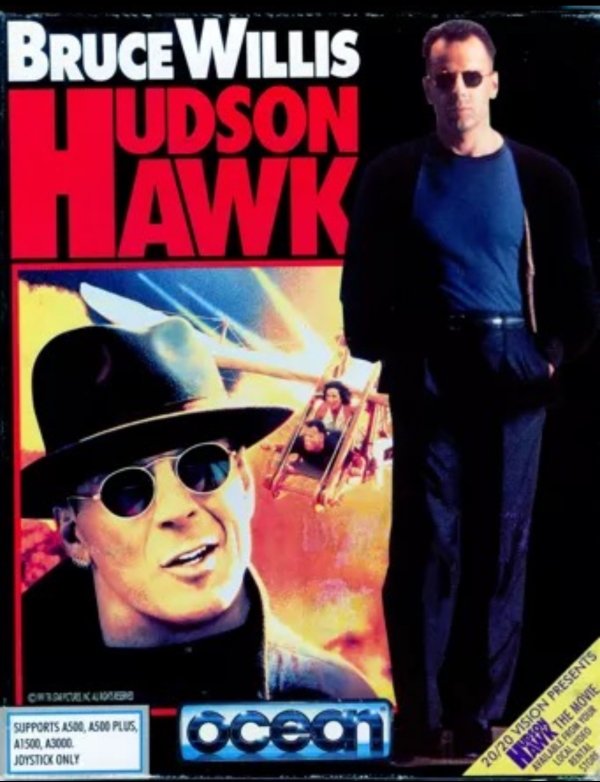
Hudson Hawk
A cheesy non pretension action comedy movie with a slight propensity to some interesting fashion.
Plus I am familiar with the Jersey area the main character being from Hoboken.
Bruce had an art deco type fashion vibe like a more modern **** Tracy.
 

Attachments

  • IMG_5444.jpeg
    IMG_5444.jpeg
    1.1 MB · Views: 54
Messages
18,300
Location
New York City
o283dl21g4zf1.gif

Cat People (1942) with Simone Simon, Kent Smith, Jane Randolph, and Tom Conway


Rightly considered a seminal work in the early horror genre, Cat People shows the power of letting the audience generate fear in its mind by implying more than showing, as in this Val Lewton–produced and Jacques Tourneur–directed tale of s*x, the supernatural, cats, and people.

The wonderfully named Simone Simon stars as a Serbian immigrant and fashion illustrator in New York City who has an odd fixation on a panther in the city zoo. An engineer, played by Kent Smith, pushes past her oddness to date the attractive young woman.

Cats are scared of Simon, the animals in a pet store go crazy when she walks in, and everything she does is a bit off. But Smith is smitten and just looks past all that to ask her to marry him. They marry and then she tells him she can't, um, consummate the marriage.

No one marries spun-out-into-orbit Simon for her scintillating conversation, but she explains to Kent that she's descended from the "cat people" of her Serbian village (witches, warlocks, a king, and exile are all involved) and will turn into a feral cat and kill him if she's, um, aroused.

Kent's response is, effectively, "Okay, I'll wait," so they live in separate rooms while he waits for what, exactly? Who knows? He then gets closer to his cute, not-insane, and not-cat-obsessed co-worker, played by Jane Randolph, while wife Simon spirals further into a feral frenzy to no real end.

In a Hail Mary to save his marriage, Kent sends Simon to a friend – a psychiatrist played by Tom Conway. Conway performs some hypnosis nonsense on Simon and then declares her fears are all in her head.

Throwing professional and friendship ethics out the window, Conway proceeds to hit on Simon on several different occasions. Ultimately, this will prove whether arousal does or does not turn the feline-like Simon into a wild predator cat – in the truest sense of that word.

Taking the perennial “cat fight” perhaps a bit literally, Simon and Randolph have a few encounters – one woman has Kent, one wants him – with faintly lesbian overtones. There's also an implication that, on occasion, Simon has transmogrified into a feral cat stalking Randolph. Okay.

The climax, no spoilers coming, is strange too. In a foreshadowing of The Twilight Zone, the movie says "maybe" there are supernatural forces out there. Today, the genre has gone down many roads, but at the time, not dismissing the supernatural alone was avant-garde thinking.

Lewton and Tourneur execute all this in an early noir-horror style that uses shadows to create suspense, fear, and dread. Often, the audience only sees the cat or the fight as shadows reflected on a wall or shrubs moving where the cat was. It's effective to this day.

Look for the scene in the hotel’s basement swimming pool at night – an early example of how darkness and echoing footsteps alone can terrify a person in an empty room – and the viewer by proxy. It will have you wondering if you've locked all your doors.

Diminutive Simon, with her feline looks and softly mumbled European accent, either acts well or, in playing a cat-like woman, found the one role that truly fit her. Kent, too, is well suited to play the innocent optimistic boy who falls for the wrong woman but takes a looong time to realize it.

Conway delivers his usual competent performance as the sleazy-but-mannered psychiatrist, yet it's Randolph who gives the movie its needed kick of energy. While everyone is tiptoeing around crazy Simon, Randolph, in bold America style, calls her crazy almost from the start.

Is Simon insane, or are there forces in the world that conflict with our rational understanding? The latter idea makes Cat People special: it approaches the question with respect wrapped inside artistic filmmaking. It’s not a great movie, but it’s a significant step forward for the genre.
 

Edward

Bartender
Messages
26,355
Location
London, UK
V For Vendetta is a great film, and when it came out I thought it was damn gutsy of the producers to make a movie starring a terrorist so soon after 9/11. Of course, the film plays differently 20 years later... now that its imagined dystopia is WAY more believable.

The original graphic novel that it's based on is a masterpiece, though having been written in the 80s it has somewhat different concerns and plot points.

View attachment 743888

The film was very much rejigged for the "War on Terror" era, yes. It's not a bad picture, imo. Alan Moore hated it, of course, but he hates all adaptations of his work on principle (partly to do with the way the comic book industry has a reputation for not traditionally treated its creatives so well, though within the bounds of copyright law). It's long been rumoured that there was a new version, a series, in the works; a few weeks ago HBO confirmed they're working on this. Rumour had it they were going to stick much more closely to the book, which I would like. The film had a well enough constructed narrative, but the book's was much more interesting. A more nuanced take on V, and also the situation. Whereas the film simplified it to an English dictatorship, as you know the source material featured a government that was fascistic but also populist and elected. That would be much more interesting to see teased out on screen, giving much more depth to an exploration of V's political violence, as in the sourced material. I'm hopeful HBO can pull it off. I've still not seen their series set in the Watchmen universe, but I think they'll do it more justice than the big screen outing. I hope it's a huge success, anyhow, partly because I am a fan of the book, but also because if it is I live in hope that they will take on From Hell and actually put the book on screen rather than the alternative (albeit entertaining) version we got in the Depp picture.
 
Messages
18,300
Location
New York City
The Fiances 1.jpg

The Fiancés (1963) an Italian film


Noted Italian auteur Ermanno Olmi wrote and directed The Fiancés, a documentary-like look at a young, engaged Italian couple facing a separation when the man’s company offers him a promotion and relocation package that will take him from Milan to Sicily for eighteen months.

Whatever you think about Sicily today, this is not that Sicily. This part of Sicily in the early 1960s is a bleak, sparsely populated industrial town comprising young men from the factory and some elderly people. Other than a modest number of tired-looking stores, there's not much here.

This might save the couple, who were bemoaning their fate when the young man, Giovanni, left. Liliana, the woman, figured this would end their relationship, which had been drifting on for years, especially since, as we learn later, Giovanni had – in some unclear way – cheated on her once.

Other than the ambiguous climax you'll want to see fresh, that's pretty much the plot of The Fiancés. The value is not in the plot but in the showing and telling that bring two people – and a time and place – to life.

Olmi lets his camera do much of the work here, showing us the rundown dance hall where we first meet Giovanni and Liliana. He pans the crowd of what look like locals – young and old – mainly going through the motions of having fun in this dreary place.

Giovanni and Liliana don't look like they're having fun either, but it will take several flashback sequences to tell their story. Olmi uses that time-jumping technique throughout – so much so that you will occasionally feel lost in the timeline, though, you'll still follow the overall flow.

In the culture of Italy in the early 1960s, these two should be getting married, but Giovanni is dragging his feet and Liliana doesn't seem enthusiastic. She seems more resigned simply because getting married is what is expected of a couple like them.

Having met when she was just a teenager and he a few years older, they've been dating "forever." Now his job relocation forces them to look at their relationship anew – something she's more willing to do than he is. It is through those flashbacks that we see their relationship struggle.

As he's getting set to leave, Liliana's sad, almost pleading face reveals her emotional state. When she asks him, "do you still want to marry me," you feel her sadness – with an overlay, however, of "do I even want that?" He says they'll be fine and he'll be back in a year and a half.

Off he goes into Act Two where much time is spent showing Giovanni acclimating to his new job and environment. He seems to be doing fine at the job (skilled welder), but life in this desolate town is wearing him down.

Giovanni simply has nothing to do in this barren place. He seems a loner, but even he wants company sometimes. Look for the scene where, late one night, he wanders into a small, empty diner – one senses, just to be around people. It's poignant cinematic loneliness.

Olmi also shows us the "cog like" feeling one can get when working for a large, impersonal corporation. You can read all the politics you want into that, but the history of government-run factories is not a story of self-realization or bliss for the worker either.

If you’ve come for action, you’ve come to the wrong movie: the pace is slow, and the “action” is simply the day-to-day life of a man transferred for work. Staying in a company hotel; wandering around bored on a Sunday; taking a bus to work are all scenes in Olmi's world.

It’s oddly compelling, as it feels like real life captured on film – exactly what Olmi was going for with his semi-documentary style and use of non-professional actors, even in the leads. Today, it also serves as a time capsule of early 1960s Italy.

Shot in black and white with English subtitles, this is the kind of “foreign and artsy” film that gets mocked, but it’s really just a low-budget, engaging slice-of-life picture that reveals a time, a place, and the perennial challenges of young love.

The Fiancés isn’t whiz-bang moviemaking, and it has a thin story, but like all good art, it captures a little bit of true life and humanity. Occasionally, you almost feel like you're watching a filmed version of Hopper's Nighthawks – albeit in Italy.
 

Julian Shellhammer

Practically Family
Messages
912
Beau Geste (1926), the restoration, on TCM. Crisp picture, exceptional score by the Mont Alto Motion Picture Orchestra. Some of the acting was silent-film rooted, but Ronald Coleman, as the titular character, was naturalistic. Look for William Powell playing the polar-opposite-of-suavity character of Boldini, a sneak thief. Comparison with the 1939 version is inevitable, but the '26 production is extremely well-done.
 
Messages
12,506
Location
Orange County, California
Guillermo Del Toros Frankenstein, certainly a different take on things

Guillermo Del Toro's version is considerably closer to Mary Wollstonecraft Shelley's novel than any other version of the "Frankenstein" story I've seen on film. Not exact, but when Universal Studios made "Frankenstein" they took quite a few liberties that nearly made the story unrecognizable.
 

Julian Shellhammer

Practically Family
Messages
912
Another restoration, this time of the 1925 The Phantom of the Opera with Lon Chaney, dir. Rupert Julian. Opening credits explain that this restoration is based on the 1929 re-release. The sets are enormous, the opera-goers are costumed sumptuously, the opera stage and seating are breath-taking, and the score is by Carl Davis: his work here cannot be overestimated (a personal favorite of mine is his swirling, lavish work on the BBC documentary Hollywood). The color sequences for the Bal Masque are remarkable, with Chaney dressed as Red Death, his shining, shimmering scarlet cape undulating in the wind atop the opera house. (Re-reading this makes me realize I sound like a total fan-boy). First time viewing; very impressed.
 

Forum statistics

Threads
114,745
Messages
3,181,433
Members
58,581
Latest member
MDz
Top